

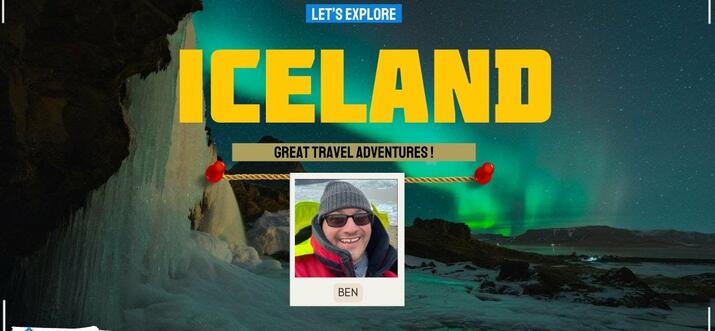
Join us for another episode of Trip101 Travel Talks where we sit down with Ben Pastore, an avid traveler, to discuss his unforgettable trip to Iceland! Ben is an experienced traveler, freelance writer, and content creator originally from Long Island, New York. He has been working as a travel agent for 15 years and has visited 81 countries across all seven continents. In this episode, discover the most stunning destinations of Iceland and iconic sights to explore. Ben shares with us his first impression of this majestic land, including the breathtaking Blue Lagoon and majestic waterfalls he can’t forget! Take note of the invaluable tips, from navigating language barriers to finding the best accommodations and meals.
Ensure your Iceland adventure is as smooth as possible by watching the video on our YouTube channel or reading the transcript below!
1. Intro [0:09 - 0:32]
Ananya: Hi, I’m Ananya. I’m a junior content manager with Trip101. Today, we’re going to discuss another exciting destination, the land of fire and ice. And Ben is joining me today, Ben Pastore, to discuss this exciting destination of Iceland. So welcome, Ben, to this session with us. We’re quite excited to have you here.
Ben: Thank you, Ananya. Glad to be here.
2. About Ben Pastore and travelling [0:32 - 5:19]
Ananya: Ben, before we dive into Iceland as a destination, I would like to know a little bit more about you. So please tell me where you’re from, what you do, and how you ended up becoming a traveler.
Ben: Okay, sure. I’m originally from Long Island, New York. I was born and raised there. For about the last almost 10 years, I’ve lived in Houston, Texas. Most of my life, I’ve been a volunteer minister, but I also needed something to pay the bills because as a volunteer, you don’t get paid. I found early on that travel was both a job and a passion. For many years—about 15 years—I worked as a travel agent for an agency on Southampton, Long Island. I found I was my best client because I was always looking to travel. Once you get the taste of it, that wanderlust takes over. Even researching trips for other people, I found myself drawn to wanting to visit various destinations.
I come from a family of travelers; my dad was always a big traveler, learning to appreciate various cultures, foods, and landscapes. To me, this is what refreshes me. So once I started, probably in the late 90s, I was pretty much hooked from then on.
Ananya: Okay. And when did you start documenting on your blog and on your social media channels?
Ben: Yeah, I realized at a certain point—this was never the goal—but as I traveled, I had a whole bunch of firsthand experience that could be valuable. To date, I’ve traveled to 81 countries across all seven continents.
You learn a lot of things. I started, oh, maybe in 2013, I started my Trip Accomplice blog and began documenting some of my lessons learned, destination pieces, and showcasing them. Just over a year ago, I started creating some video content—nobody wants to read anything anymore; they just want to watch it. And that coincided well with when I got a drone and started capturing some drone photography. I’ve always enjoyed travel photography as well. For the past, probably a dozen years, I’ve been a freelance travel writer. So basically, all this information I had and people asking me for advice, I put it out there as a labor of love.
Ananya: So it grew pretty organically. Like, you started off as a travel agent, then you started traveling yourself, and then you had a lot of information you wanted to share with everyone else.
Ben: Pretty much, yeah. I’m from the United States originally; I traveled to all 50 states, and I got to see the country really well. There are differences in the regions. But when you go international, that’s a big step forward, and that’s what piqued my interest. From the late 90s on, I traveled to a few places internationally—up to then, maybe about five countries or so. But then it just grew from there.
Ananya: What was your first international trip?
Ben: So technically, my first international trip, I was about eight years old. My family went to Italy. And back in the early 80s, it was a bigger deal than it is today. What I really liked about that trip, as I recall now, was that Europe wasn’t as much of a tourist destination as it is now. It was just authentic culture. We spent some time on the island of Sicily, where my mom’s from.
And it was really authentic. I would say it’s lost some of that now, as more people are aware and travel more, but back then, going to Italy was a big deal.
Ananya: So as a kid, you were going back to also familiarize yourself with your roots, because that’s where your mom is from.
Ben: Yes, I was eight years old. I didn’t have much choice in the matter.
Ananya: And then, as an adult, which was the first one that you yourself planned?
Ben: I went on a cruise to some Caribbean islands with friends, but the first trip I really planned myself was my honeymoon. This was 25 years ago. We went to Italy. My wife’s family is from an island off the coast of Italy called Ponza, a beautiful, under-the-radar, authentic Mediterranean island. Then I planned a trip through Austria, Germany, France, and ended up in England.
This was in the late 90s, 1999. We had the chance to sample all these destinations. That was the first one I really put effort into. And once that happened, I was hooked.
Ananya: So Italy is where it all started for you?
Ben: Yeah, I guess you can say that. Literally, genetically, that’s where it all started for me, and I took it from there.
Ananya: And since you are yourself from Italy, at least your roots are, that’s pretty great that all your significant journeys also landed up there.
3. Trip to Iceland [5:19 - 8:17]
Ananya: So let’s get into discussing Iceland a little bit now. When did you do your trip to Iceland? Was it the first time that you were visiting?
Ben: Yes. The trip we’re talking about was in September of 2023. I’d been wanting to get to Iceland for a while; I just had other priorities. My wife, for example, likes warm places, so if you’re looking for warm places, I wouldn’t recommend Iceland. But we went in September specifically because it’s not the peak tourist season. It’s a little bit warmer, rates for accommodations were a little bit lower, and flights were a little bit lower. It was still within the period where we could hope to see the Aurora Borealis—the Northern Lights. That factored into when we chose to go. So it was cold at night, but it wasn’t like it would be in a couple of months. We basically went during the shoulder season.
Ananya: Did you have to drag your wife to Iceland, or did she agree willingly?
Ben: No, we love the outdoors. We love natural beauty—just being out in creation. We enjoy that even more than cities. We had a couple of friends who were going to join us, and we decided to do it in the format of a road trip. There’s a lot to see, and really, everywhere is beautiful. One of the best things about Iceland is that there are many gorgeous destinations one after another, and they’re very easily reachable. My wife would have liked to be on a beach in a bathing suit. We did go to a beach—not in a bathing suit—but the natural beauty, I don’t know how anyone could complain about that. It really was spectacular and was a motivating factor.
Ananya: Yeah, I’ve seen some of the photos and videos on your channel. I don’t think anyone has anything to complain about as far as the beauty is concerned, for sure. Back when you were in your travel agent days, do you remember planning any trips to Iceland for clients?
Ben: So at that time, Iceland really wasn’t as popular as it’s become. Iceland started to get featured in movies and TV shows, and that drew a lot of interest. When I was working in the travel agency, it was around when Icelandair started up and you could do a layover. I looked into it for some clients.
I actually looked into it for myself as well, but at the time, it wasn’t the popular destination it’s become. One of the things I noticed, and again, I wasn’t there during peak tourist season, but the population of Iceland is only around 300,000. There were more tourists in the country than inhabitants.
I could see why it becomes so popular; it’s clean and beautiful everywhere you look.
But the infrastructure is still being developed to handle the influx of tourists. With social media and movies, you see these locations, and they really are even better in person than on your screen. It wasn’t anywhere near as popular back then, but for good reason, it has gained popularity.
4. Expectations from Iceland [8:17 - 10:34]
Ananya: Based on what you expected, when you were doing your research, how did it turn out to be when you were in Iceland, experiencing it yourself? Did it match up to what you had planned?
Ben: Yes, I would say very much. There’s so much content out now about it. Back then, there was maybe the Lonely Planet Guide and maybe DK had one for Insight Guides, but now there’s a lot more. What I really appreciate is I was able to, in my research, find some off-the-beaten-path sites. The main tourist sites—I’ll say this—don’t skip them. They’re popular for a reason; they really are worth visiting.
Even though there will be crowds, they’re popular for a reason. Another point I should mention, especially for those who may have some limited mobility, is that many of the main sites are directly off what’s called the Ring Road. This is a road that goes all the way around the country, which is an island. You can just be driving, and then suddenly, you’ll see it over there or you’ll see a giant parking lot full of cars. I was able to discover some spots a little off the beaten path, and those were my favorites. The country holds so many jewels.
As I said, it’s just not as developed because of the minimal population. And for instance, in the middle—I didn’t even go in the middle—you need a special type of SUV to handle what’s called the F-Roads, these gravel roads. There are so many places tucked away. It doesn’t take you long to get away from the crowds and be immersed in the natural landscape.
Ananya: So the main attractions that you would want to visit—they’re well connected, and it would be easy to go around?
Ben: Yes. And for those who just don’t want the hassle, there are guided tours. There were tour buses that took them to all the spots. So that’s an option as well. We decided to rent a car just to have the flexibility because even though September was a pretty good time of year to go, this is ultimately an island in the North Atlantic, and the weather from one day to the next can vary—one hour to the next can vary greatly. So having the flexibility to go here or there as we chose really helped out.
Ananya: Okay, yeah, that makes a lot of sense.
5. How long was the trip? [10:34 - 13:33]
Ananya: How long was your trip? How many days were you in Iceland?
Ben: About 10 days, 9 or 10 days. You could spend a lot more time there, although I would say eventually you’re just going to get variations on the theme. You’re going to see a lot of glaciers, a lot of volcanoes, a lot of waterfalls everywhere. Eventually, it’s just more waterfalls, more glaciers.
Some just stand out more than others, so I would say it was a good amount of time. We didn’t do the whole Ring Road. We just went about a third of the way around to the eastern side of Iceland to the Jokulsarlon glacier.
There’s a glacier there that’s basically about the size of Switzerland, and then we made our way back across to the west side. Forgive me, Icelandic is a very tricky language.
Ananya: Oh, I completely understand.
Ben: It’s called the Snaefellsnes Peninsula, I believe—that’s what it’s called. It’s a peninsula north of Reykjavik, the capital. So we went across and then back to Keflavik, which is where the international airport is, which is on the bottom-left corner of the island, sticking out maybe about 20 minutes from the famous Blue Lagoon and Grindavik, where we actually had lunch near the area where the recent volcanic eruptions have been.
Ananya: So in about 10 days, you were able to cover at least a third of the country?
Ben: Yeah, and more than that, I would say we hit the main sites. As far as the most popular, famous tourist destinations, we hit the important ones like Gullfoss, Skogafoss, and Seljalandsfoss, along with the black sand beaches by Vik. We did a glacier hike and visited the Snaefellsnes Peninsula. There’s a mountain I’m not even going to try to pronounce—Kirkjufell or something like that.
It was a terrible day for weather that day, but we visited the Blue Lagoon and hit all the main sites you’d want to see. They call it the Golden Circle. I’ll try to pronounce it—Thingvellir—it’s one of the UNESCO World Heritage sites there in Iceland. It has the history of the island. So it was enough to see the highlights, but if you want to see every corner, you’ll need more time.
Ananya: So 10 days is enough to see the main spots, and then if you want to go deeper into the country, you could plan for longer. And you mentioned that there’s a central part with gravel roads where you need a special vehicle. Maybe it’s a separate trip altogether to do that area?
Ben: Yes, exactly. In fact, while we were there, some friends of mine who had gone to Iceland years ago and were also visiting at the same time, they drove the Ring Road on their first trip. This time, they spent their time in the interior. They rented vans equipped to handle the gravel roads, and you can sleep in them as well. So you can reach some very remote spots that way.
Ananya: It depends on the time you have and the type of traveler you are.
Ben: Exactly. That affects what you prioritize.
6. First day in Iceland [13:33 - 14:34]
Ananya: When you landed in Iceland, on your first day there, you said the international airport is not in the capital city. Keflavik is a peninsula, right?
Ben: Yes, it was, I believe, an old U.S. Air Force base. That’s where the international airport is. There is a Reykjavik airport, but that’s more for domestic flights and flights from, I believe, the Faroe Islands. Chances are, if you’re an international traveler, you’re going to come into Keflavik—the airport code KEF. While we were in the area, that’s also where the famous Blue Lagoon is.
The Reykjanes Peninsula is very geologically active. There’s steam coming out of the ground, and it looks like you’re on the surface of the moon. The landscape is quite fascinating. Since we weren’t going to be back in the area until the end of our trip, we decided to go to the Blue Lagoon at the start. We thought, okay, this is going to be really touristy—it’s a big tourist attraction, and everything else in Iceland is pricey. But it was unique, relaxing, and enjoyable, so despite the crowds and the price, we thoroughly enjoyed it.
7. Blue Lagoon [14:34 - 16:33]
Ananya: So did you go straight from the airport to the Blue Lagoon?
Ben: Yes, we did. At the Blue Lagoon, you’re required to shower first. They give you robes to use, which is good because it’s cold. The water is nice and hot, and they have different pools with varying water movements, like waterfalls and jets that help you relax.
There are also various muds you can apply to your skin. Since we wouldn’t be passing by again, except for an early return flight, we figured we’d do the Blue Lagoon right after landing because it’s just a 20-minute drive from the airport.
Ananya: It’s also a cool way to get rid of your flight exhaustion.
Ben: Exactly. Most flights from North America are overnight, so to get in and just soak in this nice hot water—with a drink in hand, since there’s a bar right in the lagoon—it’s a pretty great way to start your Iceland trip.
Ananya: Yeah, that sounds like a really cool way to start. So after the Blue Lagoon, did you head over to your first stop or check into your accommodation first?
Ben: Yes, we drove through Grindavik, which is a town that’s been shut down due to recent volcanic activity, and then headed to a tiny town called Borgarnes. I chose that because of the accommodations, which were these cool dome tents at a hotel. We wanted a base of operations where we could go in each direction, and each destination would be only an hour or two away. That way, we didn’t have to move around too much. Being east of Reykjavik and east of Thingvellir put us in a good location to visit sites like Gullfoss, Geysir, and Haifoss.
8. Main attractions visited [16:33 - 17:26]
Ananya: So the main attractions were all pretty close, like within an hour’s drive?
Ben: Yes, within that time frame, you could reach them. A lot of people from Reykjavik do the Golden Circle tours that cover Gullfoss, Geysir, and Thingvellir in one day. By staying in the area, we had the flexibility to visit places at our own pace, even going early to avoid tour bus crowds coming out of Reykjavik.
Ananya: And you had your own car, so that gave you the ease of planning according to your convenience.
Ben: Absolutely. And especially to stay at a unique place like we did—an Airbnb—it was convenient. I understand there is some public transport along the Ring Road, but to reach these places, you really need your own vehicle.
9. Waterfall & national park [17:26 - 20:37]
Ananya: Which attractions did you visit? You mentioned there’s a waterfall; I’m sorry, I can’t pronounce the names, but one was a waterfall, and the other was a national park?
Ben: Yes. In the Golden Circle area, we visited Gullfoss, which is a river that plunges into a chasm with a very impressive waterfall and raging waters. It’s very windy from the waterfall mist.
Just down the road is a town called Geysir, which is where all the other geysers in the world get their name. There’s a spout of hot water called Strokkur that erupts every five minutes or so. The original Geysir has been dormant for a while, but Strokkur is active and attracts many visitors. On our way back, we stopped at Thingvellir, a UNESCO World Heritage site.
This is where the various clans of Iceland used to come together, almost like a parliament. There’s a term for it that I can’t remember or pronounce. It’s also the spot where the North American and European tectonic plates meet. There’s a location called Silfra with crystal-clear glacier water where you can see North America on one side and Europe on the other. My friend snorkeled there, so you can snorkel between the plates. It’s not a whole lot to see underwater, but it’s a unique experience both literally and figuratively.
Ananya: So was your friend able to see the difference between the plates, or is it more of a perception thing?
Ben: It’s basically a chasm. You have a wall of rock on one side, which is Europe, and a wall of rock on the other, which is North America, and you’re right between the plates. For those who don’t want to snorkel, you can walk between the plates. There’s a rift through the national park where you can walk between them without going underwater. The underwater experience is just more dramatic, and it’s a cool thing to say you did.
Ananya: But it’s a significant geographical feature to witness. Seeing the tectonic plates of the earth in person is quite something.
Ben: Yes, exactly. You have that kind of access there.
Ananya: This is also the spot where you mentioned you can learn about the history of the nation because you said the clans used to come together.
Ben: Yes, they have really nice visitor centers with clean restrooms, cafes, and souvenir shops. If you want, there’s even a film about the site’s history. For those wanting to educate themselves on Icelandic history, Thingvellir is the premier spot for it.
Ananya: Yeah, because the rest of the attractions, as you mentioned, are more or less natural features. This one also has heritage attached to it, so if one wants to learn about the history of the nation, that would be the spot to visit.
10. Gjáin [20:37 - 38:12]
Ananya: You were visiting Gullfoss, Geysir, and Thingvellir from your base, right?
Ben: Yes. And one day, we also visited a place I found thanks to YouTube. I was looking for off-the-beaten-path spots and came across a place called Gjáin—I hope I’m pronouncing it right. It’s spelled G-J-A-I-N. It’s like driving across the moon—barren, rocky landscape. And then, all of a sudden, there’s this lush green valley with waterfalls, almost like a little garden hidden in the earth. Further up that same river, there are two more waterfalls called Haifoss, with a stunning gorge a couple of hundred feet high. Because of the light refraction, you get beautiful rainbows. Visiting Gjáin and Haifoss together made for a perfect day.
Ananya: So you were exploring these natural attractions for the first two days?
Ben: Yes, and on our second day, we went down to another very popular site called Skogafoss, which is a sheer waterfall visible right from the road. Many people take selfies or “kiss pictures” in front of it. You can also climb about 300 steps to the top. Once you get up there, you not only have a great view, but there’s also a trail that leads to more cascades and waterfalls beyond it. There’s even a glacier up there. It’s a beautiful spot. We also went to Vik, a little town with a famous black volcanic sand beach called Reynisfjara. It has interesting rock formations, like sea stacks, and hexagonal basalt columns. It’s a lovely stretch of beach.
Ananya: That sounds amazing! So it was a mix of waterfalls and beaches?
Ben: Yes, and just around the corner from Skogafoss is Seljalandsfoss, a well-known waterfall easily accessible from the Ring Road. It has a concave area behind it, so you can actually walk behind the waterfall. Just nearby, there’s another waterfall called Gljufrabui. It’s hidden behind a crack in the rocks, almost like a secret room with a waterfall cascading into a little cavern. Both are accessible in one day, so we hit those.
Ananya: That’s a lot of waterfalls! Plus one beach for your wife.
Ben: It was too cold for a beach day. I should mention, though, that Reynisfjara Beach has warning signs because of rogue waves. Sometimes, the surf is rough, and waves can come in unexpectedly, so you have to be careful. Luckily, the weather was calm the day we were there.
Ananya: Good to know! And with all these major spots, you mentioned paid parking. Is that something travelers should expect at most of these tourist areas?
Ben: Yes, especially at the main tourist spots. Iceland has started implementing paid parking at many popular sites to help fund infrastructure improvements. So you’ll need to make sure you pay for parking. If you’re renting a car, be mindful of this. It’s all to support the infrastructure, especially given that there aren’t many people living in Iceland to fund it otherwise.
Ananya: Especially if you’re renting your own car and driving around, that’s something to be mindful of. For tour buses, I guess they handle it for you. So, what did day three look like?
Ben: On day three, we had booked a tour for a glacier hike. It was actually supposed to be an ice cave tour, but I was a bit disappointed—it was awesome, but it wasn’t as advertised. I’d recommend using a different tour operator than the one we used. While it was rushed, the experience itself was still amazing. The glacier ice has this beautiful blue color because it’s dense and old. However, since it was the end of the season, the “ice cave” was really just a tunnel.
Even though it wasn’t what we expected, it was still cool. The glacier runoff creates these little blue rivers winding through the ice. And the scale of the glacier is just impressive; it’s like Iceland has this giant cap of ice on top. We were on the Kotla glacier, which sits atop a volcano that’s overdue to erupt. If it does, it’ll melt the ice quickly, causing floods. The town has contingency plans in place, but it’s a reminder of how raw and active Iceland’s nature is. There’s volcanoes, glaciers, rivers—all constantly in action.
Ananya: It sounds like seeing all these geographical features in action is like witnessing what you read about in school happening in real time.
Ben: Very much so. After the glacier hike, we moved further east and stayed in a cabin in a town whose name I can’t pronounce. It was along the south coast and near the Jokulsarlon Lagoon, Diamond Beach, and other sites. The landscape there is almost moonscape-like—very volcanic, empty, but beautiful in its own way. There are interesting rock formations and huge stretches of empty land. The glacier in that area is enormous, with fingers of ice reaching down through the mountains.
Our main day in that area started with a tour of Fjallsarlon, a smaller glacier lagoon near Jokulsarlon. This one is more enclosed and quieter, which was nice. We took a tour where they provided very warm clothing—it was essential since we were visiting a giant block of ice in Iceland. They took us across the lagoon in a zodiac, so we got close to the icebergs that had broken off. Each trip varies because the icebergs aren’t uniform, but we got to see them up close.
Ananya: And did you get right up to the face of the glacier?
Ben: Yes, they even gave us a chance to taste a little piece of the glacier—some of the purest water you’ll ever drink. It was definitely worth it. After that, we went to Jokulsarlon Lagoon, which is also beautiful. Across the road from there is Diamond Beach, where chunks of ice from the glacier wash up on the black sand. The pieces look like diamonds scattered across the beach. It’s surreal to see a beach covered with chunks of ice.
Ananya: That sounds fascinating. A beach covered with ice—it’s such a contrast to the tropical beaches most people think of.
Ben: Exactly! It’s a unique experience to see a beach with big, shiny chunks of ice.
Ananya: Yeah, it definitely sounds quite fascinating for sure. Like, a beach covered with chunks of ice.
Ben: You don’t usually associate beaches with ice, that’s for sure.
Ananya: Yeah, exactly, because whenever you think of a beach, it’s always a tropical destination where it’s warm.
Ben: That’s right. I should mention that visiting Diamond Beach was a highlight for me. On our way back to our cabin, I found a hidden spot thanks to my research. There was a little turnoff with no signs—at least, not when I was there—but it led to the Múlagljúfur Canyon. In my travels to date, I would say this is the second most beautiful place I’ve ever seen.
The hike from the parking lot takes about 45 minutes to an hour, and it’s a bit tricky in spots. At one point, you have to cross a river by stepping on stones. But once you get there, you’re rewarded with this stunning valley. There’s a huge waterfall, hundreds of feet high, with birds circling around. The canyon itself is deep, with another beautiful waterfall further in. It’s volcanic, so the rocks are dark, and the contrast with the green scenery makes it look like something out of a fantasy novel. I did a couple of drone flights over it, and it was just spectacular. I’m so glad I did my research, or I would’ve missed it.
Ananya: It’s not a popular attraction, the canyon?
Ben: It’s not as well-known. There were some cars there, so clearly people knew about it, but it wasn’t as packed as other locations. For example, there wasn’t even a sign from the Ring Road. I think it’s only a matter of time before it becomes a staple, like Seljalandsfoss or Skogafoss. But for now, it’s a hidden gem. If you have moderate fitness, I highly recommend it. Again, I’d rate it as the second most beautiful place I’ve ever been.
Ananya: Now I’m curious to know what the first is.
Ben: I knew you’d ask that! The first would still have to be Milford Sound in New Zealand. It’s just so amazing. There are similarities—the dramatic green landscape and high mountain peaks. In many ways, New Zealand is similar to Iceland. Iceland is a little rawer in terms of nature, though. You won’t find many trees or forests there. But this spot in Iceland is one of those hidden gems that I’m thrilled to share here because it was just one of the best scenes from my entire trip. I put a little video together because it was that mesmerizing.
Ananya: If it’s your second most beautiful place in the world, then that’s definitely saying a lot.
Ben: Yes, absolutely.
Ananya: Is the picture in your background from the canyon?
Ben: No, this isn’t the canyon. This picture behind me was taken on the side of the road. I live in Texas, and this would easily be the most beautiful spot in Texas. It’s actually just a grazing area along the coast, with grasslands and lots of sheep. Then, as you go inland, it gets very mountainous. This particular shot was taken just outside the town of Vik, and I used my drone to capture it.
I should mention that one of the things that drew me to Iceland was watching videos on social media and YouTube with beautiful drone footage. Recently, at the main tourist attractions, they’ve banned drones. So I took it to places where it was still permitted.
Ananya: So they don’t allow drones at the main attractions?
Ben: Yes, you’ll see a little symbol with a drone crossed out at places like Skogafoss, Gullfoss, and Seljalandsfoss. So just keep that in mind. For those shots, you might have to rely on climbing high instead.
Ananya: So that’s why finding these off-the-beaten-path attractions was even more important for you?
Ben: Exactly. Iceland’s landscape is stunning, especially in September when it’s still green before the snow comes. It’s really the kind of place where you want to capture aerial views. After the canyon, we crossed Thingvellir and went to the Snaefellsnes Peninsula. We only had one night there, and this is where I wish we’d had more time. The weather can change quickly. We had great weather most of the time, but the one day we had for Snaefellsnes was extremely windy and rainy—almost like a hurricane.
I tried to pump gas, and the wind nearly knocked me over. The clouds were so low you couldn’t see anything, and it was raining heavily. It was too bad because we missed out on some spectacular scenery. You’ll definitely want to bring clothing that can handle wet weather because storms can pop up at any time, especially near the coast. Having a waterproof outer layer is crucial. The weather can fluctuate so much, so having layers and a waterproof shell helps you enjoy Iceland regardless of conditions.
Ananya: That’s a really helpful tip. So that one day, were you able to venture out at all, or did you have to stay indoors?
Ben: We did venture out, but it was difficult. We were along the coast, and the wind was whipping so hard. The clouds covered most of the scenery, and the visibility was poor.
Ananya: So you weren’t able to see much that day?
Ben: No, it was mostly covered. But that day we had something else planned—the Northern Lights. This was one of the reasons I chose September, hoping to catch a glimpse of them. It’s a bit of a gamble because you need a combination of clear skies and a magnetic storm from the sun hitting the ionosphere. You might have one and not the other, or vice versa. We did get to see them, but the colors weren’t very intense with the naked eye. You could see the shifting lights, but it wasn’t as bright as in winter months. However, with the camera, you could capture the colors better.
Ananya: The 10 days you were there, how many nights were you able to see the Northern Lights?
Ben: We were able to see them about three nights. Every night we’d go out to look for them, but it’s all very natural and unpredictable. If you come in the summer, you’ll have daylight almost all night, so it’s harder to see them. But in winter, they’re more striking. If you’re really keen on seeing the Northern Lights, I’d suggest going later in the year during colder months. Some areas might be off-limits because of the weather, but you’ll have a better chance of seeing them brightly.
Ananya: If you’re able to endure the cold, then that sounds ideal.
Ben: Yes, even in September, late at night, especially on a clear night, it got pretty chilly.
Ananya: You mentioned that your camera captured the lights better than the naked eye. Do you need a special camera, or does an average camera also capture them better than your eye?
Ben: I just used my iPhone in night mode. A tripod is preferable, though, because any kind of low-light situation requires the camera to be very still; otherwise, it’ll be blurry. With a tripod, you can get beautiful shots of the stars as well. You can even do a time-lapse to see the stars rotating or capture the Northern Lights moving. A tripod helps a lot, but you don’t need a special camera or filters.
Ananya: Anything apart from using your hand, which definitely moves.
Ben: Exactly, something that keeps it still. A tripod or just propping it up on something works.
11. Accommodation & meals [38:12 - 47:23]
Ananya: Now it’s time to discuss the places you stayed at a bit. There were three spots you chose for your stay, right?
Ben: Yes. The first one was in Borgarnes, an Airbnb dome—like a geometric, tinted dome. It was interesting because it had a hot tub, which was perfect for Iceland’s cold weather. You could sit outside with a drink and enjoy the view.
Inside the dome, there was a unique setup. You walk in, and there’s a freestanding structure with a bedroom on one side, a living area with a TV, and a kitchen with a table. In the center was the bathroom with a shower, and on top was another bed. We were two couples, so my wife and I stayed on the top. It was a unique arrangement.
Ananya: Did it feel big enough to accommodate four people?
Ben: Yes, we were comfortable with it. We’re good friends, so it wasn’t an issue. But if you’re not that close to your travel companions, it might feel a little cozy. For families with kids, it would work well. Kids would probably love the setup. It was a bit awkward at night if you had to use the restroom, as you had to climb a ladder. There was also a skylight at the top, so if the Northern Lights were more intense than when we were there, you’d have been able to see them from inside. Overall, it was comfortable, and we didn’t spend much time there other than to sleep.
Ananya: It sounds like a nice setup, especially with the skylight for potential Northern Lights sightings. Was it in a good spot for seeing the lights if they were there?
Ben: Yes, being in Iceland with very little light pollution, if the skies are clear, you’ll have a good chance of seeing them.
Ananya: So it was well-suited for seeing the Northern Lights if they were visible. What about meals at this accommodation? Were they available, or did you have to pick up supplies from nearby outlets?
Ben: One night, we went to a small market nearby in town. It’s a tiny town, so we just picked up a few things. In the mornings, we’d make bacon and eggs, a simple breakfast, and use pods for the coffee machine. There was a decent restaurant nearby as well. I should mention that Iceland is challenging to do on a budget. Food is especially expensive, but it’s very good, particularly if you enjoy lamb or stews. Surprisingly, the bread was really good too. I didn’t expect to enjoy the food as much as I did, especially given the chilly weather.
Ananya: That sounds nice!
Ben: It was, even though it was expensive. I’d say around $20 to $30 per person for a meal, even a simple one.
Ananya: And that was the first accommodation, the dome. Where did you stay next?
Ben: The second place was on the eastern side of Iceland’s south shore, near a town called Kirkjubæjarklaustur—though I can’t really pronounce it. This was a little cottage by a lake with a nice porch, good Wi-Fi, and close enough to the road to be convenient but far enough to avoid any noise. It was dark at night, so if it had been clear, we could’ve seen the Northern Lights. We stayed there for two or three nights, I think. It had bedrooms, a washer and dryer, and heaters for drying our wet clothes, which was very useful.
Ananya: Sounds cozy. And what about the third place?
Ben: The third one was a small cabin on a working horse farm at the beginning of the Snaefellsnes Peninsula. We only stayed there for one or two nights. It was a charming wooden cabin with a bedroom on top and one on the bottom, a comfortable living area with a kitchen, and a nice porch out front. It was another night where we were able to see the Northern Lights. For families or groups, these Airbnbs were a great option since they had rooms, kitchens, and living areas. There aren’t many hotels in some of the more remote parts of Iceland, so having these kinds of accommodations was nice for our self-sufficiency and privacy.
Ananya: I see, so you mostly chose these cabin and cottage-type accommodations. Were these more readily available in Iceland?
Ben: Yes, you could stay in the towns, but we were there to experience the natural beauty, so we wanted to be away from it all. Each place had its own charm and personality. They weren’t just generic apartments; between the dome, cottages, and cabins, each had its unique character.
Ananya: That makes sense—being surrounded by nature enhances the Icelandic experience. Were you mostly picking up supplies from nearby towns and cooking within these facilities?
Ben: Yes, we did. For the cabin on the Snaefellsnes Peninsula, we mostly ate out, but there were towns nearby where we could get groceries. One night, we picked up some ribs from a market and decided to cook them at the cabin. Some places even had grills. Iceland isn’t like some countries where stores and restaurants are open all hours, so this flexibility was helpful. One night, I just made pasta at the cabin.
Ananya: Earlier, you mentioned the food you enjoyed in Iceland. Were you able to try some authentic Icelandic dishes, and which ones did you like?
Ben: I was partial to the lamb stews. With so many sheep around, lamb dishes were plentiful, and they were delicious. The warmth of a stew was also perfect for Iceland’s damp and chilly climate. Icelanders also love their coffee, so you’re never far from a good cup. Hot chocolate was also a great comfort on cold days after a hike.
Ananya: Coffee and lamb sound like go-to options in that weather. Were there other types of food options available?
Ben: Yes, you could find other types of food, though there isn’t much fast food. I appreciated the local dishes, especially anything lamb-based. I enjoyed it more than I expected, which was a nice surprise.
Ananya: And you were trying these dishes at the small-town restaurants?
Ben: Yes, but it depended on where we were that day. Iceland is not as developed in terms of dining options in remote areas. For example, we’d have to eat lunch before heading to certain sites like Gjáin because there wouldn’t be any restaurants there. Most visitor centers had cafes, which were good options for lunch. They’re prepared to handle tour buses, so it was convenient to eat there before going out to more remote locations.
Ananya: That’s thoughtful of them to have cafes at the visitor centers.
12. Tips & advice [47:23 - 49:38]
Ananya: I know we’ve covered some tips already, but if I ask you for your top three to five tips for visiting Iceland, what would you say?
Ben: Sure. For a first-time visit to Iceland, many people head straight to Reykjavik, which is really the only city with a true “city life” feel, but there are more impressive places to see. I wouldn’t spend much time in Reykjavik if your goal is to explore Iceland’s nature.
Finding a base of operations is key. Staying in an area with the sites you want to see nearby allows you to explore without moving around too much. I would also recommend renting a car, even though it’s expensive. Having that freedom makes a huge difference, giving you flexibility with your itinerary and allowing you to reach off-the-beaten-path locations.
For clothing, bring layers. A good base layer, a fleece or puffy jacket, and a waterproof shell will cover you in most conditions unless it’s the dead of winter. Also, bring comfortable hiking shoes that can handle getting wet. Iceland’s outdoors can be muddy and wet, so make sure your shoes are durable.
Lastly, I’d say to respect the locals and the environment. Icelanders are very friendly, but there’s some frustration with tourists who aren’t mindful. Once, I didn’t see a sign about a restricted area, and I felt bad when someone pointed it out. It’s important to respect their hospitality, their beautiful country, and try not to disrupt the local life.
13. Language barriers [49:38 - 51:13]
Ananya: So throughout our conversation, we’ve struggled with Icelandic names. Did you have trouble with the language while you were there?
Ben: Fortunately, almost everyone speaks English, especially at tourist sites, visitor centers, and restaurants. Signs are in English, except for speed cameras, which use Icelandic. But Icelanders are very accommodating, so language wasn’t a barrier for us—just remembering the place names is the real challenge!
Ananya: Good to know that English is enough to get by, but the names are definitely tricky to recall and pronounce.
Ben: Yes, Icelandic has a rhythm, and you start to recognize certain words that appear frequently, like “foss” for falls or “jara” for beach. So, you can get a sense of the language, even though for a lot of things, I don’t even know if my tongue moves that way.
14. Souvenirs [51:13 - 52:14]
Ananya: Those are great tips. My last question is, did you pick up any souvenirs while you were there?
Ben: Not really. I bought a headband that says “Iceland” to cover my ears one day. This t-shirt I’m wearing I actually made myself. Souvenirs are pricey, but you can find good outdoor gear, wool products, and Nordic-inspired jewelry. For me, though, my photos and memories were the best souvenirs.
Ananya: Those sound like good suggestions if someone wants to pick up a keepsake.
15. Sign off [52:14 - 52:46]
Ananya: It’s been great discussing Iceland with you. Thank you so much for joining me and sharing about your trip. I hope that viewers will find this information useful and it will help them plan their trips too.
Ananya: Sounds great.
Ananya: Yeah. So with that, we will sign off for today. Bye.

History
Get Trip101 in your inbox
Unsubscribe in one click. See our Privacy Policy for more information on how we use your data