

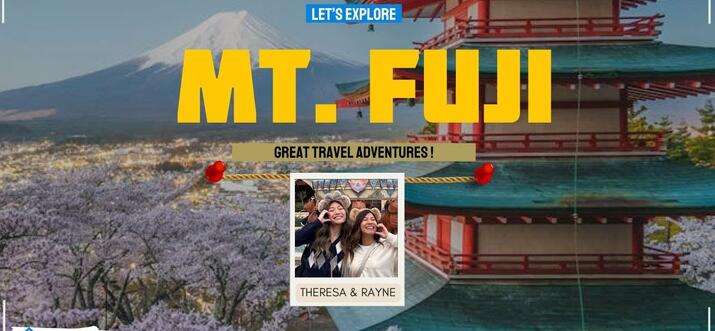
If you’re visiting Japan soon, watch our thrilling episode of Trip101 Travel Talks. This time we sat down with Theresa and Rayne to hear about their unforgettable adventure to Mount Fuji in Japan! Theresa runs her own video production company, Le Creative Productions, which she uses to tell stories of fascinating places. Meanwhile, Rayne is a medical-student-turned-film-student who also has a passion for storytelling and works with Theresa. In this interview, they take us through their epic journey and tell us more about what it’s really like to climb this iconic peak, their favorite spots, and tips for making the most of your own trip to Mount Fuji. Plus, you can get the lowdown on meals and facilities, transportation and accessibility, navigating the language barriers, and unique souvenirs to take home!
Head to our YouTube channel now to watch the video or read the transcript below!
1. Intro [0:08 - 1:15]
Ananya: Hi, I’m Ananya. I’m a junior content manager with Trip101. Today, we’re covering an exciting destination. It is partially becoming, and in recent times, it is one of the most recognized natural attractions in the world. I’m talking about Mount Fuji of Japan. Joining me to cover this beautiful destination, which I’m sure a lot of people across the world are widely interested in, are Teresa and Rayne. They are videographers and photographers who made this beautiful journey to Mount Fuji last year, capturing it in all its glory during the autumn months, when they also got to see beautiful foliage.
They are among the 20 to 30 percent of people in the world who have had the rare opportunity to see Mount Fuji without cloud cover or other natural restrictions. I’m very pleased to welcome you, Teresa and Rayne, to share about your trip to Mount Fuji last year.
Theresa & Rayne: Hello, thank you for having us.
2. About Theresa & Rayne [1:15 - 2:34]
Ananya: I’m excited to hear more about your trip, but before that, I want to know a little bit more about you. So, let’s start off with what you do. Would you like to go first, Theresa?
Theresa: Yeah, I’ll start. So, I am a videographer and own a video production company called Lea Creative Productions. I also help business owners create engaging content for their social media.
Rayne: You should tell people where they can find you.
Theresa: Oh, where they can find me? So, yeah, my Instagram handle is theresa.lee, and my business account is Lee Creative Productions.
Ananya: And how about you, Rayne? What do you do?
Rayne: I am a photographer and videographer, part of Teresa’s team at Teresa Lee Creative Travel. We make videos for businesses in travel, and I also have a YouTube channel, Raine Roses, where I share our travel experiences.
Theresa: Yeah, you have to check out Rayne’s recent video. She’s very detailed about where to go to see Mount Fuji.
Ananya: I love the energy between you two, promoting each other. So cool!
3. Motivation to make travel videos [2:34 - 5:58]
Theresa: I guess I’ll start. I was never in this industry. Before this, I worked in corporate finance for several years, but I was pretty miserable. I hated my job—it was mundane, and I felt pointless. So one day, I had an epiphany: I’m going to move to London. I packed most of my stuff in storage, took one suitcase, and went to London on my own. Living in London allowed me to travel around Europe on weekends, and that’s when I took photography seriously and filmed a lot. I fell in love with storytelling through video. From there, I thought, maybe I can create a business and make videos for businesses in the travel industry.
Ananya: That’s amazing. You went from corporate Theresa to entrepreneur Theresa.
Rayne: She transformed! Traveling makes you do different things and go out of your comfort zone, for sure.
Theresa: How about you, Rayne? What did you do before becoming a YouTube star?
Rayne: I was in the medical field, which is very different. Travel sparked everything for me. When I was in Tasmania during medical school, I started taking photos and documenting my travel journeys and hikes. I realized that photos alone weren’t enough to tell the story I wanted, so I started exploring video. Back then, people weren’t doing as many videos, and we were still using big DSLRs. I loved how video combines many elements, like sequencing, audio, and shots to tell a story—it feels like art. It turns out I have a knack for it.
Theresa: I’m so glad you never stopped.
Rayne: I actually went from medical school to business school, where I studied marketing and communication. I took a film course, and my professor, who was an old-school film expert, said, “Rayne, don’t ever stop making videos.”
Ananya: As someone who has seen your videos, I can say you chose well.
Rayne: Aw, thank you.
Ananya: You’re really skilled at it, for sure.
Theresa: Hashtag humble!
4. How long have the two of you known each other? [5:58 - 9:02]
Ananya: How did you two meet?
Theresa: It was in 2019.
Rayne: 2019? Did you count it?
Theresa: Yes, I’m pretty sure it was 2019. I was still adjusting during that period after my career change.
Rayne: Yeah, that’s seven, eight years now.
Theresa: No, just a few years. We met at a photography walk through a group in Melbourne. Only a few of us were doing videos, so we naturally connected and started talking. We’ve been friends ever since.
Rayne: Theresa was the first to ask, “Rayne, do you like travel vlogging?” and I was like, “Yeah!” That’s how it all started.
Theresa: When we met, we talked about how much we loved creating content, and our dream was to make a travel video. Last year, that dream came to fruition when we had the opportunity to film.
Ananya: So, last year’s trip was also a huge milestone for your friendship.
Theresa: Yes, it was a test! We traveled together for five weeks.
Rayne: More than that, actually! We went to Korea, Japan, Hong Kong, Malaysia…
Theresa: Typically, if you can travel with someone for two weeks, you can live with them.
Ananya: I agree. Traveling together can make or break a friendship.
Theresa: It’s true. It’s like a relationship.
Rayne: Yeah, it felt like we dated for those two months.
5. Love for travel [9:02 - 18:23]
Ananya: That’s amazing. Let’s go back a bit. I want to know more about where this travel passion started for you. Theresa, did you travel a lot as a child?
Theresa: I was born and raised in Sydney. My parents immigrated from Vietnam to Australia by boat, so we weren’t wealthy, and we didn’t travel much. But I grew up in a multicultural area, which gave me a taste of different cultures. I was always curious about what life was like outside of Australia, which sparked my curiosity to explore the world.
Ananya: So when did you start traveling?
Theresa: I took my first trip without my parents at 21. I went to Thailand with a friend, and that’s when I caught the travel bug. Seeing a different culture, especially in Thailand, really opened my mind. From there, it sparked an interest, and every year I would try to visit a new country until I eventually moved to London.
Rayne: I think it’s interesting because, in Australia, we’re so secluded. It’s common to meet people who don’t travel outside their state.
Theresa: I have friends who don’t enjoy traveling. They prefer staying at home or, if they do travel, just stay in the hotel and order room service.
Rayne: There’s nothing wrong with that; it’s just a preference. But a lot of Australians love traveling because we’re so far from other countries, so when we go, we make it worth it.
Theresa: For example, when I went to Tomorrowland, half the stadium was filled with Aussies!
Rayne: Australians love to travel. It’s a privilege we really appreciate.
Theresa: There were so many Australian flags; it didn’t even feel like I’d left the country!
Rayne: I definitely want to go to Tomorrowland one day.
Theresa: What about you, Rayne? What was little Rayne like?
Rayne: I grew up in Penang, Malaysia. Penang is a small island north of Kuala Lumpur, about a four-hour drive away. It’s a holiday town but also functions as a city. It’s very rich in culture, and the food is incredible. I always tell Theresa that the best hawker food is in Penang.
Theresa: It really is amazing. I miss the food there.
Rayne: Growing up in Penang was interesting. In the 80s and 90s, big hotels and industries started investing there. So, we had an international airport, and I could travel to nearby places like Singapore and Thailand occasionally. But it wasn’t until I moved to other cities, like Kuala Lumpur, for studies, that I started thinking about what else was out there. Moving to Australia and having the chance to go to the UK, even once, showed me a different way of life. The sun sets so late in summer – it was a revelation!
Ananya: That sounds beautiful. Yeah, that’s quite a starting revelation. When you see, go out into the world and that things are quite different everywhere else. It gives you like a really, it makes you reflective and gives you a new perspective on everything that you do. You stop taking things for granted a little bit. Personally, for me, that’s a really sense of traveling. It widens your worldview.
Rayne: Yes, I like the point that you say on perspective because that’s really like the biggest thing that I like take from travel. And a lot of times when people just say, oh, like it widens your perspective and stuff like that. But I think in a deeper sense, it opens up your world. It lets you open your heart for things, right? And when the world’s bigger, like you’re able to gain this like different skills of being able to understand where people are coming from, even though you are completely in a different, it’s a different world that you’re living in.
You have different worldviews. And because of like perspective, you’re able to like just understand, step and empathize with the work we’re doing, even though we’re videographers, we’re writing scripts. When we’re editing, we’re deciding like how the story should go. For us, traveling, it gives us that it always tells you like, oh, what if there’s another side of the story? Things that people are not pointing out or what if it’s there and people, it’s so important but people are missing on.
Can we highlight that? Like it gives like the content or like the things that we make for businesses for us. Like it gives them a reason to exist along the online, even.
Theresa: Yeah. There’s many lessons we learn from travel, right? So it means particularly is like what I learned from all the travels that I did is that I learned to like embrace uncertainty and be okay when things don’t work out because it doesn’t come out of the time.
So I’ll just give you an example. So I planned this huge trip to the U.S. and Mexico for a month. And I was supposed to go with this particular person but a month before they decided that they’re gonna ditch me and they’re like, no, I’m not going with you and I was like, okay, I’ve got a month.
Rayne: The test of friendship.
Theresa: Let me find someone else too. First of all, I was like, can I get these flights the details transferred to someone else. Secondly, it was like, oh, any other friends want to travel with me? So then I will ask all my friends like, guys, a month till the trip, anyone want to come? No one could come because they needed more time to apply for leave. At that point, I had no choice. I didn’t want to fall for the trip. So I was like, you know what, I’m just gonna do a solo trip.
And to be honest, like it turned out better than I expected. Some friends met up with me along the trip and I made friends along the trip. So I never felt lonely or anything but at the same time, I’ve always had this mindset where I was always scared of things. So I think that really changed everything around where I’m like, you know what, people can be kind and nice. At that point, I felt like I’m gonna achieve anything now too. I just had this spark of inspiration or like energy in me where I’m like, you know what, I feel like anything is possible at this point. I think that led me to move to London and step from a nine to five to own my own business. Now I can serve my clients where, you know, business owners, especially the one in the travel industry. Yeah, like I now can help them tell their stories. It shifts your mindset, didn’t it?
Rayne: You were scared before and then you’re like, I don’t want to do it. I don’t know how to do it. But then when you did it, oh, like it wasn’t that hard. And you get back that control. It’s like, last time it’s always used to be like people are dictating my life live but I did it.
I can do this and I can do anything I set my mind to. I think that’s what Theresa is. She’s like that. When she put her mind to something, that’s what I really learned from her. She’s, I’m gonna do this and they’ll be like, okay. And then next time, the next thing she’s doing it.
Theresa: Yeah, I think that’s cool. Yeah. That’s what travel has taught me. It’s like anything is possible. Sometimes we create stories in our heads when it’s not true. Yeah.
Ananya: That’s so cool. It’s a new realized your strengths. Yeah. It’s not just a journey into the world. It’s also a journey into yourself. Yeah. You’re right.
Theresa: I think so. I think so. Thank you. What lessons have you learned, Rayne?
Rayne: For me, it’s really just more of the perspective thing that is the most important. Like that, yeah. I think that really came close to my heart amongst both of us. Like, Theresa’s more the execution girlie. Like, I’ll be like anything technical, like setting stuff like that, you know, Theresa’s there. And then when it’s me, like I come, like for me, we have to shoot it this way. We had to tell the story this way. It gives me more of that side of like seeing things in a different way. I just like talking to people.
Theresa: Rayne has the vision. So he comes to vision or the idea. Rayne will come up with the idea. And she will like, I don’t know how to do this. And she will pass it to me. I don’t know how to do this.
Ananya: Let’s work on this together. We both balance each other off well in that way. Yeah.
6. Trip to Mt Fuji [18:23 - 32:14]
Ananya: Let’s get into discussing your trip a little bit now. I want to know who planned it. How did you come up with this idea that you were traveling, I think four countries together? So what, how did it, how did you plan it? What was your original thought behind the trip? Especially the last bit amount, Fuji’s, what experience were you looking for when you planned that?
Theresa: Oh, wow. We planned the trip one month before. Wouldn’t recommend. I would say yeah. Don’t recommend to plan a month in advance. If you are planning to go there to film.
Rayne: Or take photos for us, like we were like, we want to film things. And yeah, like that was just like, we’re going to bring our cameras. Imagine. Okay. So there’s a very different thing between in the industry. A girl, like, okay, I’m saying this in terms of it’s not sexist or anything, but really being a girl and a videographer is a tough job. You have a lot of gears to carry and the gears are not tiny. If you’re filming on a full-frame camera, it is huge. You need a nice lens.
It is bigger. And then you not only have one lens, you have a few lenses, and then you only not have one camera. You might have two cameras. All of the ads on those are weights and lenses.
You are not considering lights, microphones, tripods, gimbals. Those are heavy. So it’s typically like a very muscular job that takes a physical toll on your body. And then all of us were like, “We can do it. We can definitely do it.” In our head, we’re like, “Yes, let’s do it!” Didn’t think it through. As a photographer, it’s easier when you’re just going to take photos. But yeah, I would not recommend planning a trip for two girls one month before for such a long trip. We learned.
Theresa: We couldn’t split the trip actually, because I think a month is a long time to pack all our clothing and everything all at once. If we’d split our trip, we would have been fine.
But I think it’s just that because carrying the weight of all our clothes and everything for a whole month – five weeks, really – try not to go shopping as well. So that’s just a tip. If you want to film, split it up a little bit.
Rayne: Yeah, we wanted to do autumn because we’ve always wanted to see the autumn foliage. For any creators, autumn or spring is very beautiful, especially autumn because of the colors. Yeah, like it just makes things pop extra nice. That’s why we chose October to end of November. Our trip spanned that time frame. I think it even went close to December as well.
Theresa: We were there until December, right? Yeah, so we got back in December. We planned our trip to see the autumn leaves. Probably the most popular time, apart from Sakura, the cherry blossoms, so the second most popular time will be that period. And in Japan, we went in November, right? Yeah, it was November. And I think we thought that was good timing, but because of global warming…
Rayne: Yeah, so we researched it and they were telling us like, those are going to be the right times to go. But last year it got pushed back, and I heard this year is going to get pushed back as well.
So everything’s just getting pushed back by around a month. We were actually so disappointed when we were in Seoul because we wanted to see the leaves turn yellow, and it looks very beautiful next to like the grand palace, but we missed it completely. Yeah, we were so upset throughout the trip. That’s why we want to talk about Fuji. The last leg of our trip got us so emotional.
Theresa: Yeah, so just to give you some fun facts – throughout the trip, we planned to see Mount Fuji, because that was going to be like the highlight of the trip. We were always checking our phone because there’s a thing called “Fuji cam” where you can go online to see whether Fuji is actually visible. And like we were checking every day.
So like we were checking it. It’s either cloudy or there’s no snow caps. So Mount Fuji is bald. It looked like any other mountain leading up to us getting there, even the day before we were going from Tokyo to Kawaguchi where Mount Fuji is.
It was still bald. So we were just praying every day, “Please, please just have some snow, just a little bit of snow. We’re not asking for much.”
There was a point in Tokyo where we were like, “Should we cancel?” because we were already tired at that point. Should we just not go? We were very close to that.
Rayne: She was like, “I don’t want to go anymore. What do you think?” And I’m like, “We can’t think like that. We’ve come this far.”
Theresa: Rayne’s aunt was there a couple of days before us and she was taking photos of Mount Fuji, and it didn’t look like how we expected.
Rayne: It was just a matter of days, like less than three days.
Theresa: Luckily, while we were heading there that night, it snowed. The night it snowed. So when we got out just to check, obviously, like the night there, we didn’t know it snowed. But next morning, we walk out just to check and see if Mount Fuji was there, and then Rayne saw it, she started crying. Tears were falling down her face. I mean, I was happy, but she was just like…
Rayne: I fell on my knees. Do you understand, we’d been through so much, carrying all our luggage, doing all of this, taking photos, videos, feeling the stress and anxiety. When I finally saw it, oh my gosh. I was like, “There it is in front of us!” Because first of all, having Fuji in front of you, it’s just hard not to feel something. And I think the journey itself just made it all the more meaningful. Yeah, it broke me at that moment.
Theresa: It all led to that moment because we’re like, “Do we go? Do we not go? Is it worth it? It’s so cold.” When we got there, it was super cold; we hadn’t prepared for that at all. Luckily, we had jackets. I think it was negative degrees at some…
Rayne: Points, like in the morning it was 3, 4, 5 degrees.
Theresa: It was cold and windy, yeah. Tokyo was warmer, but yeah, you definitely needed a snow jacket for how cold it was.
Rayne: Yeah, because before Mount Fuji, we went to Tokyo, and before Tokyo, we went to Kyoto and Osaka. Those days were actually like 26 degrees. We were sweating everywhere, and then the moment we got to Kawaguchi, we were like, “What is happening? Why is it so cold?”
Ananya: Yeah, I think Mount Fuji was trying to fulfill your wish.
Theresa: It felt special. It’s good that it’s freezing cold; you don’t want it warm, right? When we stayed, it was so nice too. We didn’t stay at the typical area where the touristy spot was; we stayed opposite it, and it turned out to be better than we thought. We booked the Airbnb there because we wanted to be close to Lake Kawaguchi station. We thought, “Oh yeah, let’s hire a car because that’s a great idea.” But it turned out not to be. So that place was within our budget, spacious… oh, that’s very cute.
Rayne: Right, yeah. Typically, when people go to see Mount Fuji, you hear people wanting to go to ryokans and spa hotels for that experience. We were there to take photos, make content, and show people where to take photos. Staying somewhere more secluded was the right decision, I think, because if you look at the map, one side of the lake is very developed and the other side is not.
Theresa: And it’s empty, quiet, and so beautiful.
Ananya: Big contrast. So you picked the other side, the non-developed front?
Rayne: Yes, for context, the non-developed side is the side where your train stations will be. So don’t cross the bridge; basically, stay on the quieter side.
Theresa: I think our place was like a five-minute drive from the station, right?
Rayne: Five-minute drive? I think it was around 15 minutes. It was a drive away, yeah. But what was nice was we got picked up by our Airbnb host when we got there. We knew there wasn’t a lot of transport, and we had two cases, but luckily our host picked us up and even drove us to the closest convenience store so we could buy snacks as well.
Theresa: Yeah, because we were so hungry. We got there quite late, and funny thing is, this is something that everybody should know: when you go from Tokyo to Lake Kawaguchi, there’s no direct train.
Rayne: Oh my god, tell that mistake! Oh, that was so funny. We timed our trip thinking, “Lake Kawaguchi only takes an hour.” Rayne was looking at the map and just said, “Catch a train. Easy.” The next minute, we realized, “Oh, I think we have to catch a bus.”
Theresa: Yes, it’s a different thing. Kawaguchi-ko and Kawaguchi… Kawaguchi-ko is also Lake Kawaguchi, like the lake itself, the tourist destination. Kawaguchi is a suburb in Tokyo. So you can take the train to different suburbs like Shibuya, but then to get to Lake Kawaguchi, you have to take a bus.
Rayne: Wasn’t it almost like a two-hour bus ride? One and a half, two hours depending on traffic. It was pleasant, though.
Ananya: So you thought you’d be taking a train, but there was no train to Kawaguchi-ko and you had to take a bus instead?
Rayne: Yeah, people either drive there or take a bus. Once you’re at Kawaguchi-ko, there’s a local train that brings you around the area, but it doesn’t directly connect to Tokyo. We bought our bus ticket late, so it was sold out, and we had to get on the next bus, which was two hours later. So we had to sit and wait. But our Airbnb driver was really nice and even showed us a spot to have dinner.
Theresa: Airbnb does luggage transfers. We brought our valuables and gear, but everything else, like our other bags, we had transferred from our hotel in Tokyo. You have to do it a day before, though, not on the day of.
Rayne: Super handy – it took a lot of weight off us!
Ananya: The process of getting to Kawaguchi-ko was challenging. I thought it would be easier to get from Tokyo to Mount Fuji, but it wasn’t.
Theresa: It is, it’s just a matter of planning ahead. You can buy tickets online, but we weren’t aware and had to buy them on the day.
Rayne: Yeah, the lack of planning made it a bit harder, but it still worked out.
Ananya: And you got to see what you planned to and take the photos you wanted, so it was all good.
Theresa: Yes, even if we had gotten there early, it wouldn’t have changed much since the view was the same.
Ananya: How many days were you in Kawaguchi-ko?
Theresa: We were there for three days, two nights.
Rayne: Yeah, it was like one full day there. We checked in on the first night, did dinner and some exploring the second day, and then on the third day, we traveled around Kawaguchi-ko before heading back to Tokyo.
Theresa: And the next day, we went to Disneyland! We were crazy. We went to seven locations on that third day, starting at 6 a.m. to film and take photos of Mount Fuji. It was intense, but as photographers and videographers, we wanted to make the most of our chance to see it without clouds.
Rayne: Disneyland was a full day too. It was a lot, but we were so into it, we even forgot to eat. We had our cameras and just went for it.
Theresa: Originally, we were going to hire a car, but then we realized all the signs were in Japanese, so Rayne had this brilliant idea: let’s just hire a driver. So that’s what we did for the entire day. He took us to different spots, and it was convenient because we had all our luggage in one place. After visiting all seven locations, he dropped us back in Tokyo too.
Ananya: So these seven locations – are these already popular tourist spots, or did you identify them as the ones you specifically wanted to film?
Theresa: Yeah, we identified where we wanted to film.
Rayne: Yeah, we actually picked the places. The seven spots were popular. What we wanted to do is go there and see for ourselves if it was Instagram-worthy and if it was worth your time to visit. So we tried it out for people so they don’t have to.
Theresa: Yeah, basically.
Rayne: It was popular places.
Theresa: We really appreciated being able to see the Mount Fuji view from Lawson’s.
Ananya: Yeah, that’s the one where recently there has been news about it being fenced off, right?
Rayne: Yeah, I think they fenced it already. And I think there was a typhoon that blew it down, so they were saying they might not put it back up, but it’s still debated.
7. Expectations [32:14 - 40:01]
Ananya: Important question I want to ask now is, did it live up to your expectations?
Theresa: Oh, absolutely and beyond. Isn’t it, Rayne?
Rayne: It’s too good.
Theresa: We wish we were there for a few more days, really. Yes, because it’s just never enough. I can’t imagine if we lived there. How great would that be?
Rayne: Yeah, because when you’re on the other side, I feel like a lot of people who travel to Lake Kawaguchi are doing the tour. You can take day tours from Tokyo to a few spots, and then they’ll drive you back because it’s so accessible. So, a lot of people will do that typical touristy spot, but when you’re at Kawaguchi, like Lake Kawaguchi itself, living where we are at, the less touristy part, it’s so peaceful. It feels like the kind of Japan you’ve been waiting for. This is it. Because going to Osaka, going to Tokyo – I’m sorry, Tokyo and Kyoto, even Kyoto…
Theresa: Chaotic?
Rayne: Osaka is like chaotic. Tokyo is chaotic. Kyoto can be super chaotic because, even though it’s nice and everything, like you have the cultural stuff, there’s still a lot of people. There’s a lot of people. Yeah, and then Kawaguchi, on our side of the lake, there’s nobody, especially Yagizaki Park next to our Airbnb.
No one was there. We had a view of Mount Fuji to ourselves. We could do a picnic and everything. We barely left the park the whole time because it was just so nice, so chill. And I know if we start walking around the town area, they have the Japanese houses and stuff. Even with the background of Mount Fuji, I think in the video you’ll see us walking to dinner. Every corner you turn, whatever building, and then Mount Fuji at the back, it’s unreal.
Theresa: Yeah, you don’t have to be on the other side at all because everywhere you walk, you see it anyway. It’s so big.
Rayne: It definitely lives up to our expectations. Yeah, one thing about Fuji is the higher you go, the more magnificent the view will look. For example, we went to that place called Tenku no Torii. It’s the shrine on the mountains overlooking Mount Fuji. It’s like, shrine, Mount Fuji is here, and you’re standing here. So that is like a place where you go uphill to take photos. It’s a very touristy spot.
Theresa: Very touristy. We waited an hour in line. I think when we got there, we were like, should we stay or should we go? It was, yeah. We were conscious of time because the sun sets at 4:30. So we were just like, we need to be at our last destination, which was the main, like the one that we’d been really looking forward to going to. So it’s like, we can’t… oh yeah. So, yeah, an hour. So anyone that goes, really rethink. If you don’t have time, I wouldn’t… I personally wouldn’t recommend it.
Rayne: Yeah, but I would say that is the nicest view that we’ve seen. The higher you go, the prettier it is. That was the view that made me go, “Wow, like this is incredible.”
Ananya: Definitely, it’s worthwhile to, instead of doing like a day trip to Lake Kawaguchi, spend more time over there because I think that’s how you will be able to firstly visit all the spots that there are to see from various different angles. And then the other thing is, of course, to be able to spend time just to admire it, appreciate it.
Rayne: Yeah, yeah. Be in the moment for it. Yeah. Because like, when is the last time you get to tell people, “I picnicked next to Mount Fuji”? Like, just live there. Like, just go there and be part of it.
Ananya: From the way you’ve been describing it, too, and there are those visuals of the countryside in some anime shows. That’s the image that happened in my head from the way you’ve been describing it. You were sitting quietly in a park, having lunch, and Mount Fuji in the background. So it’s quite a nice visual in my head.
Rayne: It really is one of those special places that you get to go. It’s not expensive, but if you save a bit, you can make it happen. It’s that little sweet cherry you can reward yourself with after a year of long work. Especially the autumn foliage. Being able to see it, we weren’t able to see a lot of it.
So it’s only Lake Kawaguchi where we were able to see the autumn foliage.
Theresa: And yeah, that’s true.
Rayne: When we saw it, I was like, teary-eyed again. I was like, “Oh my god.”
Theresa: And also, if you decide to go, book two nights or extend it. It would be just in case it comes out for one of the days. That’s why we chose that. So it was backup, just in case.
Ananya: Because it didn’t snow, though, on the first night that you were there. That’s when it snowed, right?
Theresa: That’s when it snowed. And it continued to snow. Until we left.
Rayne: But then, after the day we left, it’s not there yet. Was it gone? It was gone. The snow was there, but the mountain was there. Behind the clouds. So lucky. It’s so weird because people will tell us, like, “Oh, like you should come shoot here during this time of the day. Like, it’s a good angle.” And we never understood what that means. And then we’re there and it makes sense because Mount Fuji is so large. But then when the light comes from like different angles, it does give you a very different view. It does look good.
Theresa: Yeah. Normally sunrise, sunset is the best time. Noon, no good for anything, I guess.
Rayne: It’s still glorious. It’s still very beautiful. It is, it is beautiful. But it’s a very different feeling when you see it at different angles and different times. Because when we were at our very last stop, which is at the bridge, I think it was called the Ohashi Bridge, which is on the other side of Mount Fuji, so you’ll be traveling I think like two hours or one hour plus from Lake Kawaguchi. Mountain’s here, you go to the other side. We were able to see it during sunset, and that’s Mount Fuji, but it’s pink.
That was very magical. At every time of the day, Mount Fuji is different. The clouds, without the clouds. Even our driver, like he’s also like a tour guide. He’s telling us like, “Yeah, Mount Fuji changes every hour.”
Theresa: I think we’re very lucky to have it where it looks like it’s wearing a hat. When the cloud is up on top of the mountain, it looks like it’s wearing a hat, because that apparently is super rare. Very lucky.
Ananya: It sounds like it would be an impressive mountain to see. Quite dynamic – it seems like every hour it changes, and the experience you can have at each part of the day. And then the season impacts it so much.
Rayne: Yeah. Apparently, it increases your chances to see it during winter. Like, you see it most during winter.
Theresa: Yeah, that’s true. I think someone did mention something like that. So I guess when we went, it was, yeah, winter, because it was snowing. Makes sense.
Ananya: And then you just have a lot more in autumn.
Rayne: Don’t go when it’s summer. I don’t know what it looks like in summer. When we say you got to stay longer, what was the memorial park we went to? A lot of people take photos at the Momiji Corridor. So, like, the Momiji Corridor walk through the park – we went to Momiji Corridor. That park was so pretty.
They take the boats out from the park. And you have the swans. I think that’s the most romantic thing. Yeah. So we wish we had more time then, and we could do stuff like that to enjoy.
I highly recommend it if anyone wants to go. I feel like one day is just for you to chill, and then another day, do some touristy stuff. You have to do it. It’s touristy for a reason. Find little moments to make it your own.
Theresa: Rent a bike or something. We bumped into these other tourists, and they were like, “Oh, you can actually hire a bike at the station.” So we were like, “Oh, I wish we had time to do that because that would be really fun.”
Rayne: Yeah. Yeah. So they said it took four hours to go around the whole lake.
Theresa: And they did a day trip too. Along the lake. Yeah, so they did a day trip, and they were like, “Oh, we’re going to go back soon, back to Tokyo.” I was like, “Okay, cool.”
Rayne: They went to Tokyo, and then they went to the station, got the bikes, cycled around, and went home. Yeah. I love it. You can do it that way too. And they also have electric bikes that you can rent, so you don’t hurt yourself.
8. Meals & transportation [40:01 - 47:56]
Ananya: That’s really cool. I want to ask you about some of the meals that you had because we’ve discussed a little bit about the food in the past.
Rayne: What did we eat, Theresa?
Theresa: We wanted to have FamilyMart food. Food from FamilyMart. But I have to say that one of our first…
Rayne: Yeah, that we really enjoyed.
Theresa: Yeah, so one of our first meals was actually a five-minute walk from our Airbnb. It was recommended by our host, who drove us from the station to the Airbnb, and he was like, “You should try the steak place.” And at that point, I remember, like, it was freezing. We were hungry, and we were like, yeah, ready to eat. So we were walking, and at that point, it was like, “Oh, this area is nice,” and then we walked in and it was…
Rayne: Like a faint little light coming out from a restaurant. So imagine you’re just on the street, and it’s all dark, and you have the street lamps lighting the way. You’re just in rural Japan – it feels like that. It’s very romantic. And then we come to the restaurant, and you’re like, “Oh, what is this?”
Theresa: When we walked in, we smelled the restaurant, and it smelled so good. I was literally salivating. What’s cute about this place is the menu was in Japanese; everything was in Japanese. We had to pull up our translator app to see what they were serving.
Rayne: Yeah, there were local families there.
Theresa: It was late as well, right? And yeah, so we had steak with rice.
Rayne: Yeah, we never had steak with rice before.
Theresa: Not in Australia, no. It’s always mashed potato or salads that accompany the steak, but this, honestly, the steak was cooked so well, medium pink inside. It was so good and very cheap too. I don’t remember it being expensive at all.
Rayne: No, yeah. Apparently, a lot of people prefer steak in Japan over Australia. I get it. They kept it pretty tight-knit because when we were trying to film in there, they were like, “No filming,” even though we had a small camera. So it feels like a little half-secret. That restaurant’s like a local secret.
Theresa: All the restaurants around there closed early, so if you want to eat, time it well. You don’t want to be starving there after eight when a lot of the restaurants are already closed.
Ananya: It’s a small town, so it shuts down.
Rayne: Yeah, yeah, I think it’s charming. Yeah, it didn’t feel touristy at all. It felt like we belonged there.
Theresa: There was this other place we went to. Let’s see. We lined up at 5:30, and they opened up at 6. It’s one of those places where you have to get a ticket from a machine and wait in the queue, so we were just waiting outside for it to open. And what was so special – I mean, that place was nice too – but what was special about this place was they served horse meat. Rayne didn’t have it, but I did. I think Rayne was looking at me going, “You’re gonna eat horse?”
I was like, “But it’s well known; the restaurant itself is well known for it.” It sounds weird, but we thought we might as well try. I’ve heard stories where it’s like, having it raw, it melts in your mouth. Someone said it melts in your mouth, and I’m like, does it melt in your mouth?
Not really. I still had to chew it. Sometimes, when you have wagyu, and they cook it rare, it melts in your mouth, but this wasn’t like that. It was a little bit tough and chewy, but it wasn’t gamey or anything. So would I eat it again? Probably not, but it was a good experience.
Rayne: It’s a very nice restaurant because when you go there, walking there is very cold. Like, Kawaguchi is generally very cold, and that restaurant itself, if you go look at our vlogs, they serve this very nice set menu with hot soup, tempura, and everything served really nicely on a nice tray for you. So it’s very…
Theresa: Typical, like your typical Japanese restaurant, right?
Rayne: Always with hot soup and stuff, yeah. A lot of people like to go there. We met a Taiwanese family there; they were visiting because we didn’t know that place was famous. She was like, “Oh my gosh, you’re here! You must know this place – it’s so famous.” And we’re like, “Oh, no, we didn’t.”
Theresa: It was rated really high on Google. That’s one of the reasons why we went.
Rayne: We recommend going there for dinner because it’s not like Kawaguchi is as developed as you might imagine. Transport is going to be a struggle if you don’t have a car or a driver. They say you can take the bus, obviously, but you still have to wait for the bus to come.
Theresa: I wouldn’t recommend a bus.
Rayne: So even if it’s dinner, try to find a few places as backups. Pre-plan for that.
Theresa: Like you’re saying, the Taiwanese person we bumped into was lovely; she rented a car.
Rayne: She rented a car?
Theresa: Yeah, she rented a car and was driving everywhere.
Rayne: That’s good. See, that’s what people should be doing, I think.
Theresa: Because we didn’t have enough time. On our third day, if we were to drive ourselves, we wouldn’t have been able to go to all the places we wanted. So that’s probably one of the reasons why we didn’t hire one.
Ananya: So it makes sense to either rent a car or hire one, get a cab to go around.
Rayne: Yeah, I would say that’s like a private driver. Our private driver was very interesting; he actually does tours for the club. He was introduced to us. He was nice; he drove us to watch K-pop idols in their cars. It’s just that five-star service.
Theresa: It was very spacious, one of the biggest taxis I’ve ever sat in. It’s like a minivan – automatic doors that he opens and closes for you, super clean.
Rayne: Yeah, he functions as a concierge service with a driver and tour guide altogether. He carried our bags and everything. We were like, this is the first time in weeks that someone helped us with our stuff. It felt liberating. If you have kids or a family and don’t want to fuss about traveling, just hire a driver.
Theresa: Yeah, it’s so much more convenient.
Ananya: Yeah, and especially in a small town like Kawaguchi, it makes sense. The little time you are there, you don’t want to waste it waiting around for the bus to arrive.
Rayne: Yeah, or people do a tour group.
Theresa: Very easy if you’re on time and your time is limited.
Rayne: I don’t know about that, though; I’ve never liked tours.
Theresa: Neither do we; we like to control our day, that’s why.
Ananya: Since you wanted to photograph and take videos at your own pace, it wouldn’t make sense otherwise.
Rayne: Oh my gosh, I have to share this ridiculous story. We wanted to shoot the autumn foliage, right, obviously, and then Theresa has this one shot she wants to capture of her touching the autumn leaf. So we found the perfect tree at the memorial park – like the park before you go to Momiji Corridor – and we found the perfect tree. We were stroking the leaves for like 15–20 minutes to get that shot.
Theresa: I know! Our driver was taking photos of us, and he’s probably thinking, “What are these girls doing?” But we needed that shot.
Ananya: What a blessed leaf, right?
Rayne: You gotta find the right leaves, think about how you stroke it, the angle, and then adjust your settings. There are a lot of technical things behind photography. It’s hilarious when you think about it – like, “Wow, did we just do that for a single shot?”
Theresa: We’re the type of girls who would do anything to get the shot.
9. Airbnb & host [47:56 - 57:04]
Ananya: I want to move to the next part. I want to know about how good your Airbnb experience was. I’ve seen your video, and it looked really cool, so could you tell me about it?
Theresa: It looks like a shipping container. When you walk in, everything is open-plan – you can see the bed, living space, and kitchen all together. But what’s so special about this space is that it’s actually very spacious; it can fit four people in there. So when I first got in, I was super happy because we had been cramped for the entire trip. Especially in Kyoto, we were in a room the size of a double bed. With our suitcases, we had to tuck them under the bed; it was so small that when you open your suitcase, you’re crawling on top of each other.
Rayne: That was in Kyoto.
Theresa: Yeah, in Kyoto. So you can imagine how happy we were to step foot into this place with so much space.
Rayne: She lit up; suddenly, Theresa’s face was glowing!
Theresa: Really, the Kyoto place was so cramped that when you spread your arms wide, you could literally touch each other. But in this Airbnb, we could twirl around and were like, “Wow, there’s just so much space!”
Rayne: One thing about traveling in Japan is you really have to look at the size of the room when booking. If you’re traveling with your partner, like technically a boy and a girl, the guy might pack minimally, so it’s fine. But when you put two girls together, oh…
Theresa: I thought I was quite minimal, but then there’s Rayne. I’m like, “Where is all this stuff coming from?” When we’re sharing, her stuff is on the shelf, in the bathroom, inside the cabinet. Meanwhile, I’m packing up, thinking, “Why is all this stuff everywhere?” My stuff is always in the suitcase just in case I forget something, but Rayne unpacks everything.
Rayne: That’s what I learned – Theresa is more like, “Experience travel,” while I’m a minimalist. I go for family trips, relax, and keep things simple, so I’m ready to leave quickly.
Theresa: We’re only here for a few days! Why did you unpack everything? She’s putting all her skincare in the cabinet.
Rayne: Two girls in one place can feel a bit tight. I think that’s something I would advise people to consider. But the Kawaguchi Airbnb was good because it was spacious. For four people, it might be a bit of a struggle with space, but for two or three, there’s enough room to open up your suitcase. A lot of people say that when traveling in Japan, try to get a trunk suitcase that opens from the top so you don’t lay everything out. That was helpful.
Ananya: And even our doors had a lot of space, so apart from…
Theresa: Oh yeah, you can park your car there too if you want to.
Rayne: Yeah, so the container setup was like two containers, and there was another accommodation next to us. It’s quite cool. The amenities inside the container were really nice and very new. The bath was newer than the ones we had in our Osaka or Tokyo accommodation. It’s all automatic; you can get water filled automatically for your bath, and it heats up really well. One thing to note, though, is that everything is brand new, like electronic.
Theresa: Yeah, something I learned in Japan is that you have to press a button to heat up the water. Otherwise, it’s not going to get hot, right? I didn’t know that.
Rayne: I think it’s just Asia in general, but it definitely was like that in Japan.
Theresa: Rayne was trying to have a bath, and she was like, “I don’t know how to… was it called?”
Rayne: I tried to auto-fill it, and it did overflow a little.
Theresa: It’s because you’re supposed to press a button to release the water. Japan and their technologies!
Rayne: It was very nice, though. So I would say for $200, you get that container, space, a nice toilet, and everything new. I was able to lay out my makeup, which was very important. You have space on the other side, a place to sit in the lounge area looking outside. If it’s not windy, we were able to open the window and go out, so it’s like an indoor-outdoor living situation with a little patio outside. You have your bed; it’s very cozy. I love it. I recommend it because it’s not expensive, and if you’re sharing with more than two people, it’s just around $100 per night for two people.
Theresa: What’s interesting about our place, because it’s Japan, is that our bed was on the bottom, and there’s like a little canopy at the top.
Rayne: Just like a little split area.
Theresa: It’s like a bunk bed, but not really. One’s on top, one’s at the bottom, and you climb up a little.
Rayne: Yeah, we used the top area as storage, which was heaven. Love it, love it.
Theresa: I would love to go back there again.
Rayne: Yeah, definitely. Also, there are two containers. Our container faces the lake, but you can’t really see the lake because there are trees and stuff. On the other side, the other container, which we weren’t staying in, looks directly at Mount Fuji. So, I think if you can, choose the other container.
Theresa: That’s the better container. If I were to go back, I would just sit there and watch it. You can sit for hours and just stare at the clouds.
Rayne: Imagine walking out of your Airbnb, and Mount Fuji is right in front of you.
Ananya: The great container stay exceeded expectations!
Rayne: Yes, yeah, anyone should go. It’s the best.
Ananya: What was your motivation for choosing this particular Airbnb? Or was it the side of the lake you wanted to stay on?
Theresa: Originally, we were going to book near the station. Logistically, it was a good idea to stay there.
Rayne: Budget-wise, when it comes to ryokans or anything with a bathhouse – your typical Japanese hotel – it can get very pricey very quickly. And yeah, mind you, they’re quite old as well. So I think we were lucky to find something on Airbnb that had what we wanted. I think there are a lot of Airbnb listings that are quite new. If you’re okay with not having the full ryokan experience, it was very affordable for us. We were trying to check off a few boxes: accessibility, cleanliness, spaciousness, and a good view of Mount Fuji. It ticked off everything.
Theresa: Yes, I think also when we got to the Airbnb, it was quite new too. We were probably like the second or third guests. I think we might have shared it on our YouTube, but I don’t know whether the price has gone up since then. The last time I checked, the reviews were still quite high, and it’s very popular. So, if you want to book it, you should book in advance.
Ananya: A good host was an added bonus.
Rayne: Yeah, yeah. Apparently, the host also runs a little hotel next to the Airbnb – like an old spa hotel. This Airbnb is like a little extra thing they added on.
Theresa: And since it’s a container, you can pretty much put it anywhere, and it would work fine.
Rayne: It’s so cute, like an old couple runs the place.
Ananya: It definitely added bonus points to your overall stay.
Rayne: I love that container. Put me in there anytime!
Ananya: It’s ironic we’re using the term “container,” but you guys are saying the experience was quite the opposite – it was more spacious.
Theresa: Yeah, it was.
Rayne: It says so much about it. It’s a big container. Even when we stayed in Shinjuku, that was tiny as well.
Theresa: Yeah, I think everywhere we stayed was tiny.
Rayne: Yeah, even though they tell you, “Oh, this is a big room,” it’s relatively big, but I think it’s how they position things. With the container, it feels like it’s more mindfully designed to make it spacious. You can move things around, and it even has a fridge and microwave.
Theresa: Yeah, we had everything – even laundry. I think they had shampoo and conditioner, too. Typically, in Japan, with their amenities, they provide everything, so you don’t have to pack shampoo if you want to keep your suitcase light. You can just use what’s there.
Ananya: Seems like Rayne doesn’t agree with you on that, Theresa.
Theresa: No, Rayne brought full bottles of shampoo and conditioner. I was like, “Why?”
Rayne: I brought full-size shampoo and conditioner.
Theresa: I’m like, “Girl, you don’t need that,” and mine was like this tiny travel size.
Rayne: I’ve learned now! I’m going to Japan next month again, and I’m bringing small sizes – maybe not even bringing them at all.
Theresa: Yeah, you don’t have to bring it at all, honestly, wherever you’re going.
10. Tips & advice [57:04 - 1:00:53]
Ananya: It’s been really fun chatting about Mount Fuji and your stay in Japan, but we’re coming towards the end of this session now. I want to ask you about tips you would share with first-time travelers who are planning a visit to Mount Fuji or Japan.
Theresa: Bring warm clothes! If you’re taking photos, bring a couple of outfits. Don’t make the mistake I made by wearing the same jacket all the time. Another tip would be to hire a bike – I think that would be such a wonderful experience, riding around the lake. Thirdly, I would say just check the times of the restaurants and see when they close so you can plan ahead. When catching a bus from Tokyo to Kawaguchi-ko Station, plan ahead. Book online if you can, or, if you’re near Shinjuku Station, get a ticket in advance. And lastly, Rayne, what do you think?
Rayne: One thing about accessibility – pre-plan your trip first, just around. In the second video you saw, we went to seven different places. Going to different tourist spots can get very packed very quickly, with all the tour groups coming in and people traveling with their own cars. So, I would say try to go during non-peak hours, like super early or later. If not, just get a good vantage point.
Theresa: Yeah, early means 4 a.m. or 5 a.m., by the way, because sometimes we would go early, but it was still really packed.
Rayne: By 9 a.m., people already start trickling in. Just try to avoid those times, and you’ll have a better experience. Otherwise, the other side of the lake can get very packed. Find a driver or plan out your day to avoid that, so you have a better experience overall.
Theresa: Make sure your phone is always fully charged, and there’s enough storage on it because you’re going to be taking tons of photos.
Rayne: I agree.
Ananya: Even though you were carrying gear to film, you were still using your phones to take photos?
Theresa: Yeah, we had the Osmo, we had our Sony.
Rayne: We had a camera for photos, two cameras for videos, the Osmo Pocket, and two phones.
Ananya: Oh, six devices!
Rayne: You want to remember it all. I love looking back at everything we shot – the clips we got were so nice. The outtakes and behind-the-scenes moments are the ones we still laugh at to this day. So, capture everything you can; that’s the most beautiful thing about traveling.
Theresa: We’re really appreciative because we were able to put it all in a video. In a couple of years, we’re going to look back on that moment at Mount Fuji. It was such a pivotal, special moment for us, and our bond is stronger now, definitely.
Rayne: Was that a trick question?
Ananya: For Mount Fuji, as well as the struggles you had to capture it from various angles and in different lights.
Rayne: Our last advice is – go watch our videos!
Theresa: That’s true.
Rayne: We tried to do all the things for our viewers, like showing how to get there, our realistic experience, and whether doing several locations is worth it. Craft your itinerary based on what you personally enjoy about traveling. Do you want to stand under the sun for two hours or chill at the park? We just want to make sure you do your prep before going because traveling is a privilege. We work very hard to be able to travel, so try not to waste your time and make the most of your trip.
11. Personal favorite spot [1:00:53 - 1:03:26]
Ananya: If I ask each of you – what’s your personal favorite spot to film Mount Fuji? Do you have one that you can tell?
Theresa: It’s the one we went to at sunset.
Rayne: Oh yeah.
Theresa: What was that place?
Rayne: Yumeno Ohashi… Yumeno Ohashi?
Theresa: I can’t pronounce it properly.
Rayne: Ohashi? Yumeno Ohashi Bridge.
Theresa: With the bridge, in Shizuoka, about an hour and a half away. We wanted to film it against the sunset. I think we got there in the nick of time – we had half an hour to spare, and then we got the chance to walk on top of the bridge.
Rayne: We were just running up and down, trying to capture it. That was a cool clip, but we were so far from each other, so we were yelling. I don’t know if that’s nice for the community, but…
Theresa: Yeah, but it was nice, and the view was beautiful. I hope they don’t close that area down. That’s my favorite.
Rayne: I’d say, if you’re there, be mindful of the locals and try not to disrupt them. My personal favorite was the memorial park – the one behind it. Oh, it’s beautiful! You get to see so many things; there’s all the autumn foliage out there. If you want to shoot autumn foliage, that’s a very pretty spot. The park is big enough, and people are not too crowded there.
Another park, called Oishi Park, is very touristy, so everyone flocks there. It’s smaller, so people get packed there. But at the memorial park, people are spread out, and you’re there to enjoy yourself. There’s a section where you can go down closer to the water, take photos, and just enjoy. People are walking their dogs, there’s a cafe playing nice music. For me, it’s nice to see people enjoying themselves. If I went back, I’d spend a whole day there just to shoot or even just to enjoy, because story-wise, I feel like that park has more to tell.
Ananya: Mount Fuji and all the local life around it. Life as it goes on around Mount Fuji – is that what you like about that spot?
Rayne: Yes, exactly.
Theresa: Every day of your life.
Rayne: Yeah, it didn’t feel too made-up. It’s still pretty, there are tourists, and it’s well-maintained, but there’s still that touristy vibe. Kawaguchi really peaks in that area, and you can see everything going on. It’s a great vibe.
12. Language challenges [1:03:26 - 1:05:12]
Ananya: I just have one last question. Did you struggle with the language in Kawaguchi?
Rayne: Yes.
Theresa: I don’t feel we did.
Rayne: Oh, you didn’t?
Theresa: No, I don’t feel like we did. Did you?
Rayne: I feel like we had to translate everything. Every part of it had to be translated, even using small terms.
Theresa: I don’t remember struggling. Some people speak English.
Rayne: I think when you’re at smaller establishments and little shops, if it’s not super touristy, or if it’s just an old man – you can tell he won’t be able to speak English, so that’s fine. Just use Google Translate. I think the best tip is to use one word at a time. I used to have a Japanese friend who told me they don’t learn English in full sentences; they learn it word by word. So, for example, they’ll know “chair,” “room,” or “two rooms.” It’s a way to communicate. You can get by with sign language or just thinking about how to form your sentence with simple words. That’s the easiest way – google “chair” or “one room, two rooms,” learn “one, two, three, four,” and you’re all set. I think language is manageable, though it’s a real language barrier, but if you slow down, you can get through it.
Ananya: Try to understand each other; it’s possible. Just google a few words, and that should help make a difference.
Rayne: Yeah, Google Translate – download Japanese. The best way is to download it because sometimes you don’t have Wi-Fi. So if you have the Google Translate app, just download Japanese to English, or whatever language you use, and always have it offline on your phone, and you’ll be fine.
13. Souvenirs [1:05:12 - 1:06:55]
Ananya: Oh, and one last thing I want to know. You guys mentioned earlier that you were trying not to shop at all. Did you pick up any souvenirs?
Theresa: No, we couldn’t buy anything.
Rayne: No, we don’t normally buy souvenirs. For us, our souvenirs are the memories on our SSDs.
Theresa: I used to collect a lot of magnets. I have two boxes full of magnets, but I think since moving around so much, I’ve learned that I don’t want to buy too many things.
Ananya: So just your memories and shots that you can show.
Rayne: Yeah, the shots. We got stuff that money can’t buy – the invaluable memories.
Ananya: And that was the goal of your trip, right? You wanted to capture the beauty of the destination.
Rayne: Hopefully, one day we can do more of this for businesses that want to tell their stories, like tours and local experiences. We’d love to move into more documentary-style storytelling, like interviews for travel companies. This trip helped us solidify that traveling, figuring out logistics, and everything is possible. We had fun and were still able to make good memories and retell the story the way we wanted. I think we succeeded, and the next step for us is to see how we can share more of that with the world.
Theresa: And to anyone watching, don’t let heavy gear stop you! We enjoyed the process, and it was all worth it.
Rayne: Yes, any gear is fine – just carry it and push through. Every time we look at the footage, it’s worth it.
14. Sign off [1:06:55 - 1:07:37]
Ananya: It’s been great speaking to you guys today. Your trip was definitely a memorable one, especially since you shared it together as friends, visiting this special destination. It’s been wonderful hearing about Mount Fuji and the emotional journey you had. Thank you so much for sharing, and my very best wishes to you both in your vision to capture meaningful stories. All the best!
Theresa: Thank you so much.
Rayne: Thank you for having us.
Ananya: We’ll close our session for today.
Theresa: Bye, thank you, Ananya!

History
Get Trip101 in your inbox
Unsubscribe in one click. See our Privacy Policy for more information on how we use your data