

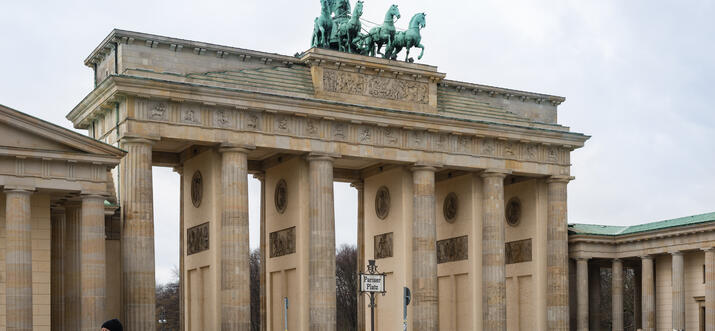
Although perhaps you may not recognize the name, you’ve definitely seen the landmarks around its area. Unter den Linden is the main vein in the beating heart of Berlin. The street has seen its heyday in the 1920s as one of Europe’s most grand boulevards but even before then it was a symbol of Prussian opulence and after the Second World War, it was considered the main artery of East Berlin. Then the wall came down and Unter den Linden went back to its former glory with hip cafes and clubs as well as iconic Berlin landmarks like Brandenburg Gate on one end and City Palace on the other. If you’re spending some time in Berlin, here is a guide to Unter den Linden.
Things to do


The story of Unter den Linden is an interesting one. The translation means “under the linden trees” and is so named for the trees that line the boulevard’s grassed median. The trees are so favored and such an iconic part of the city that when Hitler had them removed to be replaced with Nazi flags, the people protested, and he had to replant them. Walking from one end to the other grants you a beautiful little mini-tour of some of the most important spots in the city.
Brandenburg Gate
The stunning 18th-century neoclassical monument is known all throughout the world and is an iconic landmark in the city. The everlasting symbol of Berlin was commissioned by Prussian King Frederick William II. Behind it is the Berlin Wall which has been a part of major events in European history and continues to be a symbol of peace, freedom, and unity. It has been visited by many people the world over from Presidents Kennedy and Barack Obama and composer Leonard Bernstein.
Deutsches Historisches Museum
Simply referred to as the DHM by many, the museum is considered one of the most important in Berlin. If you haven’t gathered from the name, the museum devotes itself to German culture and history as well as the shared history between Germans and Europeans. There are collections of everyday life and culture like household objects and toys from the 15th to the 20th century as well as documents, arts, print, and militaria.
Crown Prince's Palace
The neoclassical building at the other end of the Unter den Linden was once home to the ruling family of Prussia until the abolition of the monarchy after the first world war. Afterward, it became a sort of museum housing modern art until it was closed by the Nazis and destroyed during WWII. Finally, after the war, the building was used as a guest house for visiting officials to East Germany before becoming a center for cultural events today.
Tip from tour guide

Unter den Linden also boasts the Statue of Frederick the Great. Don't forget to check it out! Judging by the number of biographies and research papers written about him, he is arguably one of the most interesting Germans who ever lived. And yes, strictly speaking, he was Prussian.

Tip from tour guide

The German Historical Museum or DHM, designed by architect I.M.Pei, celebrated its 20th anniversary in 2023. It's still one of my favorite buildings in Berlin! Try checking this attraction out on an afternoon or evening tour as there is less crowd in the streets and the light from the setting sun shines beautifully on the iconic building.

Tip from tour guide


Another notable attraction on Unter den Linden is Neue Wache. Here, you can see the Mother with her Dead Son sculpture by Käthe Kollwitz. The original sculpture, made in 1937-38, was enlarged by Harald Haacke to be placed in the old Neue Wache building on Unter den Linden in 1993. On rare occasions, I visit the memorial with tourists on a rainy day. The effect of the rain on the mother is something that I cannot miss myself, and together with my guests, I stop to observe and take a picture. The time of day you visit this attraction also plays a significant role in the emotions the commemoration art here evokes in visitors. Request: Please do not step so close to the sculpture. I used a zoom to take this picture.


What to eat

Café Einstein Unter den Linden
Located right on the boulevard, Cafe Einstein is popular among the tourists that come to Unter den Linden but that shouldn’t deter you from coming in and grabbing a bite. The stylish cafe has outdoor seating for the warm summer months so you can watch the crowds of people go by while you sip your coffee and have your freshly baked German cake. Cafe Einstein brings the 1920s cafe culture to the modern era.
Nante-Eck
Continuing on the trend of the 1920s-themed eateries comes this Berliner favorite. Take a step back in time and taste some classic German dishes, cooked just like they were years ago. The restaurant gets pretty busy you may want to make a reservation in advance and if you’re really feeling the 20s vibe, maybe even dress up a little. Enjoy traditional German plates like pork knuckle in beer sauce as well as modern favorites like currywurst and desserts like a delicious strudel.
Things to buy

Miniature souvenirs
Mini souvenirs are a great little way to bring back something with you on your travels. They don’t take up a lot of room in your luggage and you’ll always have something to remember your trip by. For a place with so many iconic landmarks, you’ll be hard-pressed to find something you don’t like. Try a little figure of Brandenburg Gate or if you’re lucky an authentic piece of the Berlin Wall.
Bear merchandise
The mascot of the city is a bear. A black bear is featured on the city’s coat of arms and since 1954 it was a symbol of West Berlin, but the iconic bear association with the city of Berlin goes as far back as the 12th century. Bear merchandise is found all over the place from teddy bears to gummy bears, T-shirts, and jewelry. Nothing says “Berlin” like the bear.
Travelers tips

Tipping
The best tip for eating out at a restaurant is not to tip. If you’re coming from North America you might be surprised to find that there is no tipping culture in Germany and the rest of Europe for that matter. Waiters and waitresses get paid a living wage and don’t rely on tips and might even consider it rude if you tip them. Generally, it is always easier to round up your bill to the next Euro.
Stay safe
While Berlin and Unter den Linden are very safe areas, precaution should still be taken especially in denser areas. Places where many tourists congregate have a higher chance of pickpocketing which has been on the rise in recent years. Always watch your things and don’t let your bags or valuables out of your sight. If you have any issues, keep in mind that most locals and police speak English, if you do not speak any German.
Berlin Tour Guide

Asaf Leshem
My name is Asaf and I am a professional tour guide. I hold a Ph.D. in Dark Tourism and interpretation of history. In Berlin I guide tours on such topics as the Cold War, the Third Reich, Berlin's Jewish Heritage, Berlin and Brandenburg's Prussian History, and more. I also guide in Potsdam, and I am certified to guide in the Memorial and Museum Sachsenhausen. I am also an enthusiastic runner a... Read more
Tours by Asaf

Berlin Tour Guide

Tina
Born and raised in Australia, I studied psychology at the University of Queensland but had always loved reading modern history books. I came to Berlin for a nerdy history vacation in 2017, fell in love with the city and decided to make it home. I offer tours of Berlin and its surrounds which are rich with history and packed with energy. I don’t just show my guests Berlin's sights; I also exp... Read more
Tours by Tina


Berlin Tour Guide

Matti Geyer
I was born in Berlin the year before the wall fell and thus had the fortune and privilege to grow up in a city that was growing up itself. In 2008, I decided to turn my passion for this amazing city into a career by becoming a tour guide. Both my parents lived in East Germany: My dad became a teacher, until refusal to join the Communist party ended his career, whilst my mom worked as a tour gui... Read more
Tours by Matti


How to get there

By bus
Germany has some of the best public transit in the world and is usually a lot more affordable than most European cities. The Unter den Linden is central and served by the bus lines 100, 147, 245, 300, and N6.
By U-Bahn & S-Bahn
The U-Bahn runs underground like the metro and the S-Bahn runs above ground like a train and both have stops at Unter den Linden right at Brandenburg Gate. To get there hop on the U55 U-Bahn or the S1, S2, S25, or S26 S-Bahn and get off at Brandenburger Tor station.
By bike
Berlin is very bike-friendly with no steep hills and well-maintained and marked bike paths. Bike rental shops are also found all throughout the city with prices starting around 8 EUR (9 USD).

Unter den Linden information

Unter den Linden
Address: Unter den Linden 10117 Berlin, Germany
Official website: Unter den Linden
Department of tourism website: Visit Berlin
Opening hours: 24 hours (daily)
History
Get Trip101 in your inbox
Unsubscribe in one click. See our Privacy Policy for more information on how we use your data