

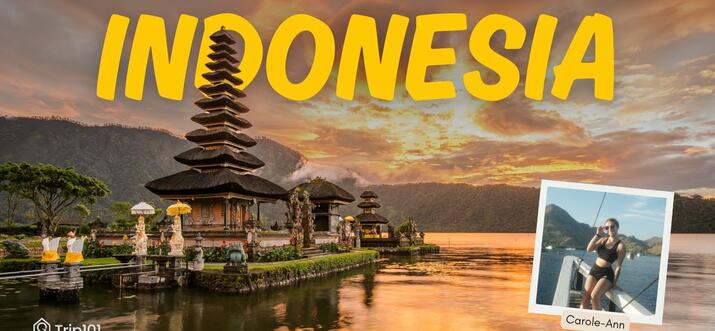
Welcome to the latest episode of Trip101 Travel Talk! In this installment, we interview seasoned traveler Carole-Ann, who spent a month exploring stunning destinations in Indonesia, including Nusa Penida, Flores, and Komodo Island. A resident of Canada, she’s spent a lot of time hopping across the globe and even runs her own travel agency. Here, she reveals insider tips on must-see spots, top accommodations with breathtaking views, ideal neighborhoods for various travel styles, and exciting activities to experience.
Whether you’re planning a serene getaway or an adventure-filled trip, these exclusive trips from someone who’s been there will help you plan a perfect Indonesian itinerary. Don’t miss these expert recommendations and travel secrets—head to our YouTube channel to watch or read the transcript below to know more about Indonesia!
1. Intro [00:00:00 - 00:01:43]
Nirja: My name is Nirja Bhatt. I am going to be interviewing one of our travelers who is from Canada. And we will be talking about a few destinations in Indonesia. And the series is largely focused on getting our viewers and readers ideas about how to plan their trip, what they can expect from their trip in Indonesia, and we hope to help you guys plan a trip of a lifetime. So let’s begin. Hi, Carole-Ann. Welcome to our Travel Talk series. It’s wonderful meeting you again.
Carole-Ann: Yes, nice to meet you. Thank you so much.
Nirja: Yeah, officially. Okay. If you could just introduce yourself, where you are from, what you do for a living, that would be great.
Carole-Ann: Yeah, perfect. So my name is Carole-Ann. I’m 25 years old. I live in Canada, more specifically in Quebec, which is the small French port of Canada. And I do have a travel agency company. I’m the founder of that agency.
And we are doing tailor-made itineraries for clients. So I created the agency one year ago. And I’m doing that full time while I was finishing a Bachelor of Degree in University. And now half I finished it in last May. So I also have a Bachelor of Degree in Communication and Marketing.
Nirja: That’s great. It must be wonderful, you know, getting to travel and just being in the traveling field full time.
Carole-Ann: Yes, it’s really a blessing. I’m really grateful to have the chance to work from everywhere also.
2. Travelling preferences [00:01:43 - 03:34]
Nirja: Right. So you must have traveled to a lot of different places.
Carole-Ann: Yes, exactly. Since I was a little kid, my parents traveled with me. And now, I haven’t stopped traveling since. And I travel at least twice or three times by year.
Nirja: Well, I kind of envy you right now. Yeah. Okay. And I’d like to ask that. So you must be traveling extensively, right? I mean, since twice a year…?
Carole-Ann: Yes, I actually do travel sometimes for one month or two months. And then I come back to Canada to see my friends and family and work from home without distractions. Because when you’re traveling, you always want to do some activities. And it’s hard to go in a cafe, sit down and work all day. So I come back here to catch up on work and then I can go back to the traveling.
Nirja: It sounds like an ideal lifestyle. So do you travel alone or, you know, with friends, family, with other people?
Carole-Ann: I do travel alone or with my partner, which has a lot of vacations day. So he can come with me. So normally I travel in a duo with someone else, but I do all the planning. And the other person, they’re already just bringing his bags and follows along.
Nirja: So you’re more of a planned traveler rather than spontaneous?
Carole-Ann: Exactly. I like to know where I will sleep and what are the activities that I can do. But I don’t have all set days. So this day, I will do that, except when I need to book an activity quickly. But I like to know where I will sleep and what there’s to do. So I don’t miss out on anything.
3. Destination preferences [00:03:34 - 00:04:08]
Nirja: That’s great. So what kind of destinations do you prefer? Like beaches, mountains?
Carole-Ann: It’s really hard. Yeah, it’s really hard to choose. I don’t really like big cities. It’s always nice to visit big cities and museums and cultural destinations. But I really prefer more of a beach town or a mountain destination. But I really can’t choose between mountains and beaches. So I like destinations that have both in the same country.
4. Trip to Indonesia [00:04:10 - 00:06:06]
Nirja: Yeah, that’s wise. You get best of the best. Okay, so when did you exactly travel to Indonesia?
Carole-Ann: Yeah, this year I traveled to Indonesia during the month of May and June.
Nirja: Okay, and why did you choose Indonesia?
Carole-Ann: I wanted a destination that was not that expensive for me to live there for two months. And also destinations that had everything that I wanted to do in the travel. So I like beaches, I like mountains, I like jungles, I like to surf, I like to hike mountains to see volcanoes. And there’s everything in Indonesia. So that was the perfect destination for me.
Nirja: Great. Can you tell us about, like just in brief about how the experience was, and then we’ll get more into details?
Carole-Ann: Yeah, the experience was just amazing. The people there in the culture are completely different from what I see here in Canada. So I came out of my comfort zone, but everyone was so sweet. I didn’t see a lot of scams or scammers. Everyone was just completely happy to live and welcoming to tourists as well. I felt really safe, and I felt that people wanted me to see their country and experience the culture. And I felt like I was a part of the community as soon as I lived in Indonesia.
Nirja: Yeah. I’m glad you had that kind of experience. I think people, you know, they’re a very important part of the location. So I’m sure our readers would love to know that Indonesia is very welcoming.
Carole-Ann: Oh yeah, yeah, yeah. Everyone is so sweet.
Bali Tour Guide

Toni Kenpachi
Hello my name is Toni and I live in Jakarta- Indonesia, I've been working as a Tour Guide since 2008, I have licensed from Jakarta City Government Tourism Office, I choose to be a Tourist guide due to my background education because I graduated from Tourism Academy, I'll be glad to assist your trip in Indonesia especially in Jakarta and surrounding areas also if you would like to do overland t... Read more
Tours by Toni


Bali Tour Guide

Dori Januhari
I am a legal and licensed tourist guide from Indonesia. I have been guiding for 20 years. I live in Jakarta, Indonesia, but I have traveled to many places in the country. My guiding areas are Java, Bali, and Lombok Island. I obtained my license from the Indonesia Tourism Ministry. On days when there is no tour, I work as an English and German private teacher, teaching mathematics and science ph... Read more
Tours by Dori


5. Indonesia's weather [00:06:07 - 00:07:28]
Nirja: And how was the season there? Was it too hot? I don’t think it would be too cold, but it might be too hot.
Carole-Ann: Yeah, being from Canada, for me it was hot, but it was the beginning of the dry season. So it was basically between 25 and 35 degrees, but it’s really the humidity that is making it a little bit hotter because there’s a lot of humidity in the jungle. But every day it was really sunny, not that windy, and it was just the perfect weather for me. Being from Canada, this is what I wanted to have when I went to Indonesia, and it was not the rainy season. So I didn’t see any rain at all during two weeks. Okay.
Nirja: Great. But do you think, you know, the rainy season could add more charm to the location?
Carole-Ann: Yeah, I’d say that it may be a little bit more complicated to travel during rainy season because, first, there are a lot of mosquitoes that come out when it rains. Also the main transportation that we used was a scooter. And when it rains a lot, a scooter is not always the best because it can hold you from going to far away destinations.
6. Six weeks in Indonesia [00:07:28 - 00:07:56]
Nirja: Yeah, that’s great. And how long did you stay there? How long was your trip?
Carole-Ann: My trip was six weeks in total in Indonesia.
Nirja: Wow. You covered a lot of ground in six weeks.
Carole-Ann: Yeah, there’s so many highlands in Indonesia, so I will have to come back anywhere to visit more. But in six weeks, I had a chance to do Bali, Nusa Penida, Flores Island, and Komodo Islands.
7. Itinerary [00:07:56 - 00:08:37]
Nirja: Okay, great. So how did you plan your itinerary for this day? Like what were the highlights you wanted to see?
Carole-Ann: First, I planned the itinerary regarding surfing because I really love to surf. So I planned it around the surf spot at the beginning, and then I planned the first part. And then the second part of my travel, I planned for the Komodo Island cruise. So everything was planned around that. So I booked a flight to Flores Island, and I planned to visit Flores and then do the Komodo cruise. So everything was around surf and the Komodo Island cruise. Right.
8. Differences between Komodo Island, Flores and Nusa Penida [00:08:37 - 00:13:27]
Nirja: And you traveled to three different places, right? Komodo Island, Flores, and Nusa Penida. So how were they different from each other? What was the general vibe?
Carole-Ann: First, I think that is a really touristy island. There’s not a lot of surf. It’s a one-day touristy island. So there’s a lot of people coming from Bali just for one day. So it’s pretty much in the middle of nowhere. It’s really nice because there’s not a lot of shops, restaurants. It’s really more for beaches, cliffs, and landscape.
And when you go to Flores, it is more of a main island. So there’s a lot of service. There’s a beautiful city. There’s a lot of people living their life. It’s really easy to have transportation as well. So it was a little bit different also.
Flores is a Muslim island. So you can hear the musky a lot of the time during the day. You can hear the songs. It’s a really different ambient. There’s less tourists because a lot of people go to Bali and people forget that there’s other islands in Indonesia. So Flores is really for more adventurous tourists. Right.
Nirja: And so a lot of different vibes. All three places have really different vibes and each of them you’d want to experience, right? Okay. So now we’ll get more into detail about your total trip. If you could tell me what you did on each of the days or just in each of the weeks that would be great.
Carole-Ann: Yes, perfect. So for the first three weeks, I was in Bali surfing pretty much. I did Canggu, Uluwatu, and Kuta. And then I went to Ubud to experience a lot of jungle activities and to see the rice fields as well. And then I went for a week and we explored a lot of beaches and cliffs. We saw a lot of hidden gems also in Nusa Peninda because we had our old scooter. So we could travel around the islands.
We were escaping the crowds of the big tourist bus. So it was really nice to see it as more of a cultural experience. And we visited a lot of traditional villages in Nusa Peninda. There’s a lot of people living traditionally. So it was a pretty nice.
And then we went to Flores. It’s a one-hour flight from Bali. And we discovered the island of Flores for four days. So we went to Sylvia Hill and Rangko Cave, which is a blue turquoise cave on the island, it’s really beautiful. And then we went to Bela Village which is a traditional village, a whole different culture that we see in Bali. And also we went to Cunca Wulang Waterfall. So we really explored the island with our private driver.
And then we went for the last week on a cruise in Komodo Islands. So we were on the sailboat for three days and we were living aboard. And we discovered all the little islands that you cannot see when you’re staying in Flores because they’re only accessible by boat. So we discovered a lot of different islands. We did a lot of snorkeling. We saw Komodo village, Komodo dragons. So it was a really unique experience. And there it was really magical.
Nirja: Right. I’ve always wanted to see Komodo dragons because I mean, they look so unique and they have such unique features. I bet it must have been a unique experience.
Carole-Ann: Yeah, this is one of the only places in the world where you can see actual Komodo dragons. So it’s really special to see them in real life and see them from really close. So it was really special.
Nirja: And did you see them in the national park or zoo or something?
Carole-Ann: It was not in a zoo. They are free to live everywhere. So it’s in Komodo National Park. And there are almost 2,000 Komodo dragons there. They’re living their life. And you’re not guaranteed to see them because it’s a national park. So you just walk in. And if you’re lucky, you can see them. And I saw four of them. So we were really lucky.
9. Pink Beach [00:13:27 - 00:14:57]
Nirja: Yeah, that’s lucky. Any other unique places on any of these islands? Because I know that there is Pink Beach on Komodo Island as well. Right.
Carole-Ann: Yeah, exactly. As you can see behind me, the background is a picture that I took at Pink Beach. I don’t know, it didn’t even look like it was a real place on earth where the sand is really light pink because of the red corals. So it’s beautiful. And nobody lives there. So it’s a completely natural raw beach with deer. And there’s only tourists coming for the day. But nobody lives there. So it’s really magical. It’s a unique thing. I’ve seen this on Instagram. And I thought it was fake, you know. But the pink sand is really real.
Nirja: Yeah, I mean, as you say, like I’ve watched some of the videos on Instagram as well. It looks something like out of a fairy tale. Exactly.
Carole-Ann: It looks fake, but it’s really when you’re far away, it doesn’t look as big because it’s a really light pink. It’s not a fuchsia, you know, but when you come closer to the island, you can see it with the sun. It’s just bright pink everywhere. It’s really beautiful. Right.
10. Nusa Penida [00:14:57 - 00:15:41]
Nirja: How many beaches could you cover in Nusa Penida? I mean, just combined, how many beaches did you cover?
Carole-Ann: In Nusa Penida, we saw three beaches, because one thing that you have to know is that it takes a lot of time to drive from one place to another, especially on a scooter. The roads are really difficult. It’s uphill, downhill, then it turns right to left. So it takes a lot of time to travel from one beach to another one. So we did Atuh Beach, and then we did Diamond Beach, Kelingking Beach, and Crystal Bay Beach. So we did four beaches.
11. T-Rex at Nusa Penida [00:15:41 - 00:17:21]
Nirja: Then I was researching Nusa Penida. I came across this beach called Kelingking Beach. And I really love that because it’s supposed to look like T-Rex, right? T-Rex dinosaur. So did you think the same? Like, did you see the shape of the dinosaur?
Carole-Ann: Yeah, we went to this beach, which is a really, really interesting and popular beach. This is one of the first pictures that you see when you look for Nusa Penida on Google. But it was really crowded, but absolutely beautiful. And the only thing is that the way to go downstairs and to go to the beach is really, it is really dangerous. You have to wear good shoes, and you have to be really careful because there are no stairs. So you have to hide down, but it’s really dangerous. And I heard that they are actually building an escalator this year to go down the beach. So I don’t know how it will look in one year, but overall, it was just a really natural and beautiful hidden, I would say hidden gem, but it’s not really a hidden gem. But when you go down, there’s not a lot of people with good shoes enough to go there. So there’s not a lot of people at the beach. So it really felt like a hidden gem when you’re actually on the beach downstairs.
Nirja: Yeah, it’s one of the things I wanted to do by the chance to go to Indonesia because I really love dinosaurs, and what’s better than seeing it, so.
Carole-Ann: It’s amazing.
12. Three Pound House [00:17:21 - 00:18:37]
Nirja: Any of the spots that you had actually planned to visit, but you couldn’t visit because of any other reason, but you feel like you should have gone there?
Carole-Ann: Yeah, in Nusa Penida more specifically, I would have loved to visit Three Pound house. Maybe you have seen it on Google, this is a little wood house in the trees with stairs like that. And people are going there to take pictures. You know, it’s really beautiful. You see the cliffs in the background, the blue turquoise water, but it was really far away from our hotel on scooter. So it was a little bit complicated to go there. And also I wanted to see Goa Giri Putri, which is like a temple in a cave. And because I was actually on my period, I couldn’t visit this temple because you cannot visit the temple when…
Nirja: Yeah, it’s unfortunate, maybe next time.
Carole-Ann: Yeah, exactly. But I mean, you have to respect the culture. So it’s really important to respect the rules. And even if you really want to see a spot, you have to respect the fact that you cannot do that. Right.
13. Indonesian food [00:18:37 - 00:20:26]
Nirja: Let’s move on to another subject and that’s food. So tell me all about, you know, what the food was like in Indonesia as a whole.
Carole-Ann: The food was really amazing. They really used fresh spices, fresh flowers, fresh herbs, fruits, vegetables. And it was completely amazing. The traditional food is nasi goreng, which is fried rice with chicken satay that tastes like peanuts. So you have peanut sauce, you have vegetables. It’s really beautiful. It’s really yummy. It’s colorful.
And you also can eat a lot of chicken curry, a lot of tofu, tempeh as well. So it was a lot of vegetable options and vegan options as well. The only thing is that you have to be careful when you’re from Canada like me and you’re not used to some bacterias. I got sick the first day because I think that I ate some raw vegetables that were washed with tap water.
So you just have to be careful about what you eat and make sure that the ice cubes, for example, are made with filtered water. But overall, there’s a lot of diversity and there’s a lot of Western food as well, like burgers, pastas. But the traditional food is a must do and it’s really delicious, beautiful, colorful. I really recommend it over eating a burger or pastas. Okay.
14. Flores [00:20:26 - 00:22:14]
Nirja: And about Flores, any memorable activity you did there?
Carole-Ann: Yeah, first, Rangko Cave was absolutely amazing. You have to take a little boat from Flores and there you go to a really little island, the middle of the sea. And then you walk into the island and you see this cave, which is completely huge when you enter it. And there’s blue turquoise water.
I don’t know how it’s possible. I don’t know the science behind that, but it’s just a little beautiful. It’s a really unique experience because you can swim in the cave and you hear all the small birds, all the flying foxes that live in the cave. It’s really unique. And also Bela Village is something that I really recommend if you want to experience the traditional culture of the indigenous people of Indonesia. So you can see traditional dance, traditional games. They offer you coffee, they offer you tea, and they dress you up with the traditional clothing. So it’s really nice and people are so happy to show you their culture and it’s not that touristy. There were only four people in the village when we visited, so it’s a must.
Nirja: It sounds like a lovely place, especially if you want to explore more of the local culture. Exactly.
Carole-Ann: If you’re really interested, yeah, if you’re interested in learning different languages, cultures, dances, it’s a really good activity to do.
15. Traditional foods [00:22:14 - 00:24:45]
Nirja: Okay, circling back to food. Are there any memorable foods you had on each of the islands, any traditional food that you’d recommend?
Carole-Ann: Yeah, I believe we covered nasi goreng and nasi tumpeng. So these are the two traditional meals. And for the starters, I really recommend the corn fritters, which is basically a chip of corn, but with some vanilla, it’s really delicious. And then for dessert, you have to try the pandan crepes, which is a little crepe made with pandan leaves. So the crepe is green and there’s coconut and sugarcane. It’s really, really, really yummy.
Nirja: Yeah, it sounds yummy as well. Maybe it’s because dinner time for me right now. Okay, and any restaurant that you can think of, any restaurant, any of the places that you’d recommend?
Carole-Ann: Yeah, I do recommend the Seaesta Restaurant, which is located in a hostel and they have a really huge range of variety. So you can eat traditional food if you want, but you can also eat Western food if you want, or if you have been sick and you want to eat something that reminds you of home. They have everything in their same restaurant and everything is so fresh. There’s a lot of people there. So you know that the food is running in the kitchen, there’s no food standing there. They have a lot of rotation. Everything is really beautiful, fresh and safe to eat. Great.
Nirja: Food also reminds me of water. Like is the water safe to drink or do you have to carry a bottle around with you?
Carole-Ann: The tap water isn’t safe to drink. You always have to buy water from the shop. So every day we bought two liters of water, and then we had to brush our teeth with the bottle of water as well. And it was really important to also be careful when you take your shower because if you get water in your mouth, you can be sick as well. The water is really, really bad and there’s not a good filter system. So you have to be careful and only consume water in a plastic bottle.
16. Accommodation [00:24:45 - 00:29:27]
Nirja: Okay, great. Now we’ll come back to where you stayed, your accommodation. So I assume you lived in a hotel.
Carole-Ann: Yeah, in the process, we booked the most beautiful hotel of my life. It was called Selini Hills, which is located on a hill. And the concept of the hotel is just little tree houses. So you live in your own tree houses, and there’s different houses on the hill.
So you have to walk a lot of stairs to go to your accommodation. But then you have a beautiful view of the city of Labuan Bajo, which is the most popular city in Flores, and also the city that you have to go to Komodo Island. And you have a beautiful view from your balcony of all this city, the sea, the boats, the mountains. And it was just amazing because, in your little tree house, you have your own shower, your own toilets. You have a beautiful bed. You have a huge balcony and a little living room as well. So with a couch. So it was really amazing to experience that. It’s a really unique accommodation.
Nirja: Right. That sounds like a children’s dream come true. Also wanted to ask that, what’s that accommodation kid-friendly?
Carole-Ann: Kid-friendly, yes, of course. But you have to know that there’s a lot of stairs to get to your accommodation. So maybe if you have a young kid that doesn’t know how to walk or if you’re scared of them walking up the stairs, maybe that’s not the best place for that. But overall, there’s a lot of place for everyone. And I know that there’s a lot of accommodation with two or three beds and also a little kitchen so you can easily go with your family.
Nirja: Right. And does it offer any other add-ons? Like, you know, since it’s Indonesia, massage would be very popular.
Carole-Ann: Yeah. This is one of the best accommodations of all the islands.
Nirja: What about the other places that you lived in?
Carole-Ann: In Nusa Penida, we stayed at the Jungle Cliff Resort, which is a resort in the middle of the jungle. So there’s nothing around. You just hear the jungle sounds at night. That’s really nice. And you have a huge pool in the middle of the jungle, but like an infinity pool. So it’s really, really amazing and beautiful and special. And it’s a little bungalows. So everyone has their own place, and its whole bungalows with a patio as well. So you can just sit down there and relax. And you feel alone, even though you are not alone, but you really feel alone in the middle of the jungle.
Nirja: Sounds like a great place. Must be great too. You know, all that sound during the night. Yeah.
Carole-Ann: It’s really special to hear that type of sound because normally you sleep in cities or in the city center. So you hear more of cars, scooters, but there you will just hear monkeys and some insects, jungle insects, you know, sounds that you never hear. And also you can see the sky full of stars because there’s no light pollution there. So you just see beautiful stars everywhere in the sky at night. Wow.
Nirja: That sounds lovely. Yeah. And did the places, they provide food, like breakfast and lunch, you know, all this, you know, facilities.
Carole-Ann: Yeah, I really choose my accommodation around if the breakfast is included or not because I really like to wake up with breakfast and then be ready for the day, you know, to not go out of the hotel hungry and then you have to try to find a spot. So every hotel that I did included breakfast. And they also had a restaurant to lunch there or to eat dinner as well if you wanted. And the food was really, really fresh, freshly cooked every morning. And there were a lot of different choices. You could eat as much rice in the morning as you wanted or pancakes. So there’s a lot of options.
17. Wi-Fi access [00:29:27 - 00:31:23]
Nirja: Right. It must be, you know, since you said in one of the places you were like isolated in the middle of the jungle, did you still have access to Wi-Fi?
Carole-Ann: Yes, they do have Wi-Fi, but of course, you have to accept the fact that the Wi-Fi is a little bit slow sometimes. It does work, but maybe if you want to do video calls, it’s better to go to a cafe where they have good Wi-Fi to work remotely because, at the hotel, it was really basic Wi-Fi, you know, to send pictures to your family, to write to them. But for video calls, sometimes it was a little bit hard.
Nirja: And what about the rest of the places? Not just the city, the normal city that you went to—is there good Wi-Fi there?
Carole-Ann: Yes, typically in Bali, there’s a lot of good Wi-Fi because I think that there’s a lot of expats and people that work remotely from Bali. So the Wi-Fi is more developed and they have really good internet speed. Of course, in Nusa Penida, since it’s an island, the Wi-Fi is a little bit hard to get. But on the main islands like Bali and Flores, it was really, really good. The only thing is that on Komodo Island, when you’re going on your cruise, you have to know that there’s no Wi-Fi.
So you really have to read for three days. Maybe there’s some boat that has Wi-Fi on board with maybe a Starlink or something like that, but most of the cruises are still not equipped with it.
Nirja: Okay, so maybe not the place for a working holiday?
Carole-Ann: No, exactly. Bali is really a good place to work, and Flores Island as well. All the main islands, yes. But all the small islands—it’s not the best.
18. Souvenirs to buy [00:31:23 - 00:34:18]
Nirja: Okay, you know, since you went to such an exotic place, there must be a lot of things to buy. So can you tell me a little bit about, you know, how the shopping is, like the shopping districts there, what kind of things you can buy?
Carole-Ann: Yeah, actually I had to buy another suitcase, a small suitcase to bring all my souvenirs with me. It’s really amazing. There are a lot of souvenirs, a lot of art, and the art market is really dangerous, you know, because I wanted to buy everything. There are a lot of traditional masks, a lot of jewelry, and jewelry like that. I mean, there are a lot of clothes, and clothes are beautiful. Everything is handmade, and it’s pretty cheap compared to what I can buy here in Canada. Clothes, jewelry, or art in general. So I really took advantage of the shopping scene in Indonesia. I bought a new suitcase and a lot of things to decorate my house here, from mirrors to cushions to art for the walls. I bought a lot of things, yeah, and a lot of coffee as well, a lot of tea, and incense too. There’s so much to choose from, and no matter what you like, you’ll find something to bring home for sure.
Nirja: Yeah, was there a specific place that stood out where you could purchase things, like maybe a local market or something specific?
Carole-Ann: Yes, definitely Ubud Art Market, which is located in Ubud Valley. This is really the place to find art pieces and handmade pieces, and they have good prices as well.
You can always bargain with them, but they have pretty good prices, and beautiful art paintings that take maybe two or three weeks to paint by hand. A lot of beautiful jewelry as well, made by hand. So Ubud Art Market, I think it’s the place. Also, in Bali, Canggu—I really recommend the Sunday Market. It’s a really beautiful place to buy everything, from food to clothes.
Nirja: Did you have fun bargaining?
Carole-Ann: I don’t like to bargain because I always cut the price in half, and then after that, we negotiate, but it’s something I have to do because, I mean, they always triple the price when you’re a tourist, so you have to do that if you want to keep your money.
19. Komodo Island [00:34:18 - 00:35:58]
Nirja: So I want to come back to Komodo Island, because I think we didn’t talk about the accommodation there. So were you on the cruise throughout your stay there, or did you stay in a hotel or Airbnb or something like that?
Carole-Ann: Yeah, you’re actually living on board. So you’re living on the sailboat, and you have your own room. For us, since we were two, we had our own room with two beds and an en-suite bathroom. It was pretty spacious, honestly. We could walk in our room, and we could also walk in our bathroom. We had a huge shower and toilet section.
Since we had two beds, we could put all our things on the other bed, and it was really spacious. Also, they cook for you three meals a day. So they have a kitchen there. You just wake up, go on the roof, and then you can eat your breakfast. It’s a really, really nice place to just relax, because you wake up, go on the deck, and take your coffee. In the night, you do the same. You walk, talk with people, play games, card games, and then everyone goes to sleep in their little rooms. It’s a really unique accommodation. It was my first time living on board, and I was not disappointed.
Nirja: The sunsets must be to die for.
Carole-Ann: The sunsets were incredible every night.
20. Interaction with locals [00:35:59 - 00:30:30]
Nirja: So, in Indonesia, they have their own different language. Was it difficult for you to interact with the local people, or could they understand English?
Carole-Ann: They do speak English, and they have a really good level of English because there are a lot of tourists, and they learn English at school from a young age. So they have a really good level of English. And also, the Indonesian local language, which is Bahasa, is really easy to learn. For example, to say thank you, it’s “terima kasih.” And there are a lot of little words like that. When you use them, people are really happy because they see that you’re interested in their culture. Also, on the island of Bali, they have another language. They speak Bahasa, English, and Balinese.
So you just have to be careful. For example, thank you in Balinese is “suksuma,” but you cannot use “suksuma” when you go to Flores, because it’s only in Bali that you can use that. You have to learn the difference and use the right language on the different islands. But if you’re speaking English, pretty much everyone will understand you, and you can travel easily with a good level of English.
Nirja: That’s good to hear.
21. Trip highlights [00:37:30- 00:39:16]
Nirja: Yeah, I think we talked a lot about lots of different things. So, on the whole, what did you like the best about this trip?
Carole-Ann: The thing that I liked the best was meeting people who are just so happy to live the way they live and who are so happy to share their culture. I really love the Indonesian culture because people are really calm, peaceful, they respect nature, they respect animals. They are grateful for everything. They are grateful for their food, for their family, for their friends, for their homes.
And it really helped me see another vision of the world. In Canada, we’re not always thankful for everything we have. It’s normal for us to have food on our plate, to have homes, and we don’t really appreciate them as much as we should. But there, they are always grateful for everything, and they celebrate everything. So every month, there’s a party for the harvest, a party for animals, a party for food. There are always a lot of celebrations each month. And everyone is just so happy. Everyone’s smiling at you. There’s a real sense of community where there’s no competition between people and between shops, for example. They all help each other, and it was just amazing to see that and to experience a culture where people are just helping each other and grateful for everything they have.
Nirja: That’s lovely. That’s a great perspective.
22. Reflections [00:39:17 - 00:40:31]
Nirja: Okay, so here’s a fun question for you. If you had to plan this same trip back, would you change anything about the trip? Add anything? Delete anything?
Carole-Ann: I would have stayed in Ubud for a few more days because this is the destination that really surprised me the most, and there are a lot of different activities to do. I think that I would have stayed in Nusa Penida maybe three or four days instead of one week because it is a really small island with not a lot of services. So maybe I would have stayed fewer days there, or maybe I would have done a day trip from Bali with a private car and transportation so it could have been easier and less stressful to visit the island. Because with a scooter by ourselves, it was a bit stressful to drive there. It’s kind of a dangerous island because there are a lot of cliffs, the current is really strong, and you cannot swim. So one week there was maybe too much. I would have stayed two or four days.
23. Safety tips [00:40:31 - 00:44:00]
Nirja: Okay, the next question I have for you is, do you have any safety tips for anyone visiting the country or the islands anytime soon?
Carole-Ann: Yeah, first, maybe when you’re not in Bali, which is a Hindu island, the rest of the country is Muslim. So you have to respect the Muslim culture and you have to dress properly. You also have to be careful, maybe when you’re a woman, not to walk alone at night. But these are the basic safety tips that you should follow in every country. I would mostly recommend having cash with you, because on the islands, it’s really hard to find ATMs. Sometimes, when you’re out of gas or in a tricky situation, it’s always important to have cash with you. You can give a little cash to someone, and they’re going to help you out easily. It’s always good to have some cash on you.
I would say it’s also really important to follow the recommendations of the medical center. I went to a travel medical center here that gave me vaccinations, including one for Japanese encephalitis, which is a common disease in Indonesia. So just get the right vaccinations to be safe, and bring a lot of mosquito cream with you because there’s a risk of dengue. There’s not a lot of crime, so the most dangerous thing is to get sick or catch a disease from a mosquito bite. Just be careful to get every recommendation from a medical center.
Nirja: I remember on the first day you got sick. Did you have to buy medicine, and was it easy to do that? Did you need a prescription?
Carole-Ann: Yeah, it’s pretty easy to get medical care in Indonesia, especially in Bali, because there are a lot of monkeys and dogs, and people sometimes have accidents with them and need rabies shots. So, there are a lot of medical centers. Lucky for me, I had antibiotics before I went, which the travel medical center had given me, so I took those. But if you don’t have antibiotics, you can easily call a medical center. They can come to your room and give you an IV and medication. Just make sure you have travel insurance to cover that. But it’s really easy to get good healthcare if something happens, so don’t be scared. Unless you’re really far into the jungle, it will be easy to access.
24. Monkeys [00:44:00 - 00:45:22]
Nirja: Great, okay, that’s good. So did you see any monkeys? I know you heard the voices of monkeys, but did you get to spot any?
Carole-Ann: Yeah, we saw a lot of monkeys, especially in Ubud. But you have to be careful because these monkeys are not wild monkeys that you see deep in the jungle. They are intelligent monkeys, and they do steal from you. They know that if they steal from you, they’ll get food or something in return. So, it’s not a really natural experience with the monkeys; it’s more about being careful with your belongings. They can be a bit aggressive, and they’re used to tourists. So, it’s not like seeing a big monkey in the middle of the jungle.
Nirja: Right, yeah, I know I’ve had a monkey snatch food out of my hand, so it’s been an exciting but terrifying experience. I get what you’re saying.
Carole-Ann: Exactly, yeah, they’re really ruthless. I saw one monkey go right up to a lady, grab her glasses, and then break them in front of her. They’re not as nice as they seem.
25. Aquatic animals [00:45:22 - 00:47:02]
Nirja: Right. Did you see any marine animals since you spent a lot of time in and around water? Any fish or anything you spotted?
Carole-Ann: I went to two snorkeling spots, and I had the chance to see them. But I know that if you’re lucky, you can see manta rays. I did see some clownfish, and I got to see turtles—huge green turtles, in fact. I saw colorful fish, but I didn’t have the chance to see a lot of marine life. There’s a lot of boats and tourists, so now it’s a little harder to see reef sharks or manta rays.
Nirja: That’s great. I really love interacting with wildlife, so I think Indonesia would be a great place to see all kinds of things.
Carole-Ann: Yeah, they do have a lot of wildlife, especially marine wildlife. I don’t dive, but maybe if I did, I would have seen more of it. But from a snorkeling perspective, it was really beautiful to see the reefs, the fish, and the turtles. But you have to be really lucky to see a manta ray. The best season to spot them is from September to November.
Nirja: Great. I’d love to see something like that. Maybe that’s when I’ll plan my trip to Indonesia, which I don’t know when will happen.
26. Tips for first-time travellers [00:47:02 - 00:49:50]
Nirja: Okay, I think we’ve pretty much covered a lot of things. But is there anything that I haven’t asked you about and you think our viewers or readers would like to know?
Carole-Ann: I have five tips and pieces of advice for people who want to go to Indonesia and do the Komodo cruise, because I know it’s a really famous activity. First, I’d say to book it in advance and then plan your trip around the sailing trip, because it can be really expensive if you go last minute. We personally booked six months in advance and then planned our trip around that. So if you want a good price, book in advance.
Also, I really recommend going from April to June, which is the beginning of the dry season. It’s not too hot, and it’s the perfect middle between the two seasons. I also recommend you bring a waterproof camera if you go to Indonesia so you can capture the marine life. And if you’re doing the Komodo cruise, I’d recommend bringing sea-sickness tablets so you can enjoy the experience to the fullest without getting sick.
Nirja: Okay, those are some great tips, especially the waterproof camera because it’s so specific, but it’s something you probably wouldn’t know unless you experience it.
Carole-Ann: Exactly.
Nirja: Yeah, I think with that, we can wrap up our interview. It has been lovely seeing Indonesia through your eyes and your perspective, and it’s made me want to go there immediately and just book my flight right now. I’m sure that’s the case for anyone watching this interview as well. Thank you so much for taking the time to give us a personal look at all these beautiful islands.
Carole-Ann: Thank you so much for having me. I really, really recommend you book your flight soon because Indonesia is more popular now than it has been for many years. So take the opportunity to go as soon as you can. You won’t regret it; you’ll have the best time of your life, for sure.

History
Get Trip101 in your inbox
Unsubscribe in one click. See our Privacy Policy for more information on how we use your data